HaYonim Cave, Archaeological cave in Galilee, Israel.
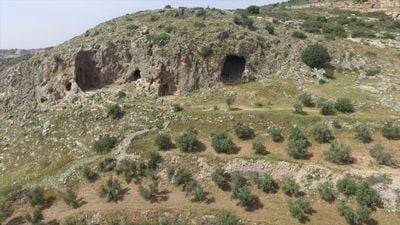
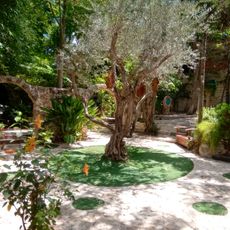
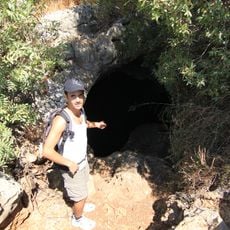
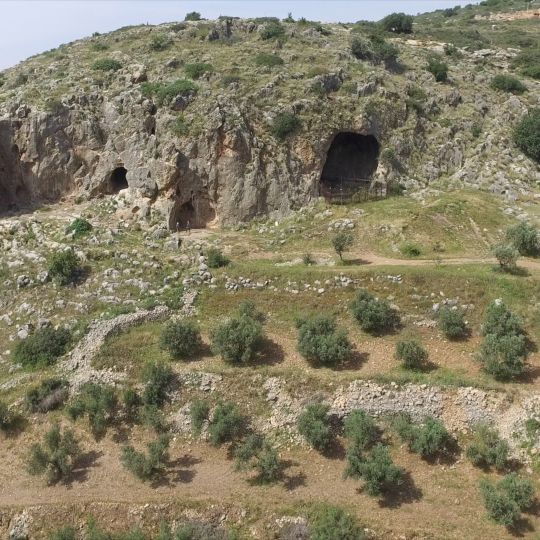
HaYonim Cave opens in a limestone bluff on the northwest slope of Har Gamal, about 250 m above sea level in the Upper Galilee. It consists of two intact and two eroded karst halls, with a fifth suggested by rockfall scars and breccia patches. Two dark openings pierce the cliff: a larger triangular one with a metal gate at its lower edge and a smaller rounded one to its left. Two artificial terraces planted with olive trees descend from the cave mouth toward the wadi floor.
Occupation began in the Mousterian Middle Paleolithic, between 250,000 and 100,000 years ago, with Levallois debitage, early blade technology and hearths. A running horse carving dated to 40,000–18,500 BP, possibly Levantine Aurignacian around 28,000 BP, is the first art object of the Levantine Upper Paleolithic. Natufian groups occupied the cave about 12,000 years ago, and from the 7th century AD shepherds used it mainly in winter, burning dung into a 3 m ash layer.
The cave's Hebrew name, Me'arat HaYonim, means "Cave of the Pigeons." Its Natufian layer, about 11,000 to 14,000 years old, held graves with jewelry and bone tools, and one grave contained the nearly complete remains of two dogs. Three caches found at the northern wall held basalt pestles, half-worked cattle ribs, and quartzite hammerstones with many tooth beads.
The cave lies on the northwest slope of Har Gamal, about 13 km east of Akkon and the Mediterranean coast, roughly 2 km southeast of Kibbutz Pelech. Two artificial terraces planted with olive trees descend from the entrance to the valley floor. Excavations in 1965–1971, 1974–1979 and 1992–2000 opened a 150 m² area inside one hall.
A wall carving of a running horse, dated to between 40,000 and 18,500 years before present and possibly to the Levantine Aurignacian around 28,000 BP, is held at the Israel Museum. It is considered the first art object found in a Levantine Upper Paleolithic context.
The community of curious travelers
AroundUs brings together thousands of curated places, local tips, and hidden gems, enriched daily by 94,382 contributors worldwide.