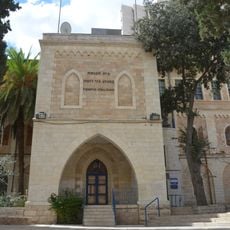
Tempio Italiano in Jerusalem, Synagogue in Jerusalem, Israel
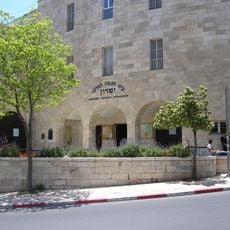
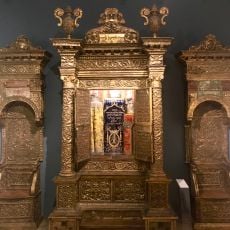
The Tempio Italiano is a synagogue on the second floor of the former Schmidt school building at 25 Hillel Street, in the Mitcham Schmidt complex. Its furnishings came intact from the abandoned synagogue of Conegliano Veneto: a Baroque gold-leaf Torah ark flanked by two twisted columns, cherry-wood panelling, walnut benches and a red marble washbasin whose figures have damaged ears, noses and mouths. The women's section repeats the original layout.
The synagogue's furnishings come from Conegliano Veneto, where Jews were confined to a ghetto in 1637 and the new synagogue was built; its ark was consecrated in 1701, as an inscription still in the building attests. Around 1900 the synagogue stood abandoned. In 1948 Venice's Jewish community and chief rabbi Elio Toaff approved handing the interior over, and in 1952 it was rededicated on the second floor of the former Schmidt school on Hillel Street.
Prayers here follow the Italian rite, the minhag of the Bnei Roma, rather than the Sephardic or Ashkenazi customs. The synagogue is one of only a handful outside Italy where this rite is still practised, alongside small minyanim in Jerusalem and Netanya. It also serves as the community's venue for weddings and other celebrations, and the 1993 film Snow in August, about an Italian-Jewish family in Jerusalem, centres its characters' cultural life on this synagogue.
The synagogue occupies the second floor of the former Schmidt school building at 25 Hillel Street, and entry is through the Nahon Museum of Italian Jewish Art, which uses it as its centre. Visitors are admitted Sunday through Thursday, following the museum's opening hours; it is closed on Fridays and Saturdays and on Jewish holidays. Services in the Italian rite are held on Shabbat and festivals, so check times before coming if you wish to attend rather than tour.
The marble washbasin in the entrance hall came from Italy with the rest of the furnishings; the original Italian rabbi broke the nose, ear and mouth of the carved figures above the taps so they would not be taken for idols. Worshippers still use it.
The community of curious travelers
AroundUs brings together thousands of curated places, local tips, and hidden gems, enriched daily by 93,614 contributors worldwide.