Tower of Flies, Medieval watchtower in Acre, Israel.
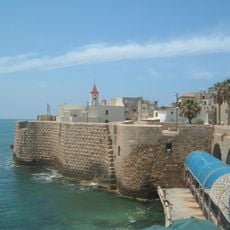
The Tower of Flies stands on a small island at the entrance of Acre's harbor, serving as both a defensive structure and lighthouse for maritime traffic. The remains reveal how medieval builders positioned fortifications to control access to one of the Mediterranean's busiest ports.
The tower's origins are uncertain; underwater excavations date its foundations to the Hellenistic period, and second-century Roman coins depict a lighthouse on the island. The Crusaders rebuilt and enlarged it after capturing Acre in 1104. In August 1267 Genoese forces seized the tower and blockaded the harbor for twelve days until a Venetian fleet drove them out.
Crusaders arriving at Acre mistook it for the biblical Ekron, whose deity Ba'al-zebub means "Lord of the Flies"; garbage left at the site reinforced the name. In Arabic the tower is called Burj al-Dubban (Tower of Flies) or al-Manara (the Lighthouse), recalling its double role as fort and beacon.
The ruins stand on a small island at the harbor entrance and are seen from the port and the Old City waterfront; the eastern wall collapsed into the water in 2020, so keep a safe distance. The site lies within Acre's UNESCO-listed Old City. About 35 m north of the tower, at a depth of roughly 4.4 m, lies the Akko Tower Wreck, a 25 m merchant brig dated to the first half of the 19th century.
The tower was linked to a heavy iron chain stretched to the shore at the Chain Tower, sealing the harbour basin against enemy ships. Crusader accounts of the 1191 siege describe ships breaking through this sea barrier. The system was rebuilt in the 18th century under Dahar al-Umar and Jazzar Pasha.
The community of curious travelers
AroundUs brings together thousands of curated places, local tips, and hidden gems, enriched daily by 92,638 contributors worldwide.