Tso Moriri, Brackish lake in Ladakh, India.
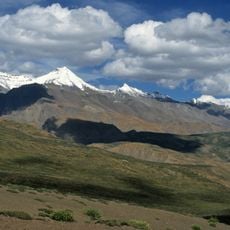
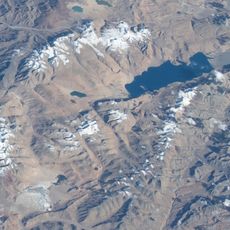
Tso Moriri is a high-altitude lake on the Changthang plateau in Ladakh, 26 km long north to south and 4 to 8 km wide, with a surface of 120 km2. In the photograph a narrow band of deep blue, still water lies between a hillside above and a flat grassy bank below. Three glacial streams, Karzok Phu, Gyama Phu and Phirse Phu, feed it, and peaks above 6,000 m such as Mentok Kangri and Lungser Kangri enclose it.
The lake received Ramsar Wetland designation in 2002, establishing formal protection for its high-altitude ecosystem. This international recognition acknowledged the site's importance for migrating bird species and their breeding cycles.
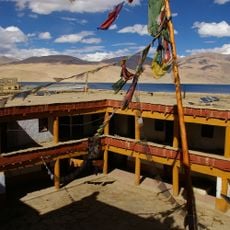
The lake's Tibetan name, Lha mo'i bla mtsho, means "high lake of the goddess"; locally it is also called Tso Lhamo, lake of the goddess. Until 1959 residents extracted salt (tsokar in Ladakhi) from the lake. The Korzok Monastery on the western bank, about 400 years old, draws Buddhist pilgrims, and tented accommodation serves visitors from May to September.
A special permit (Inner Line Permit) must be obtained from Leh administration before visiting the area. The best time to travel is May through September when mountain roads are open and accessible.
Tso Moriri is a remnant lake: it survives from a much larger prehistoric water body, as do Tso Kar and Pangong Tso. Its southern outlet is now blocked, so it is endorheic, yet the water stays only slightly brackish and palatable. Before 1959 locals extracted salt (tsokar in Ladakhi) from the lake.
The community of curious travelers
AroundUs brings together thousands of curated places, local tips, and hidden gems, enriched daily by 92,779 contributors worldwide.