Coronation Bridge, Concrete arch bridge across Teesta River, Darjeeling District, India
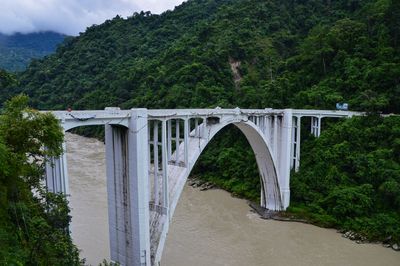
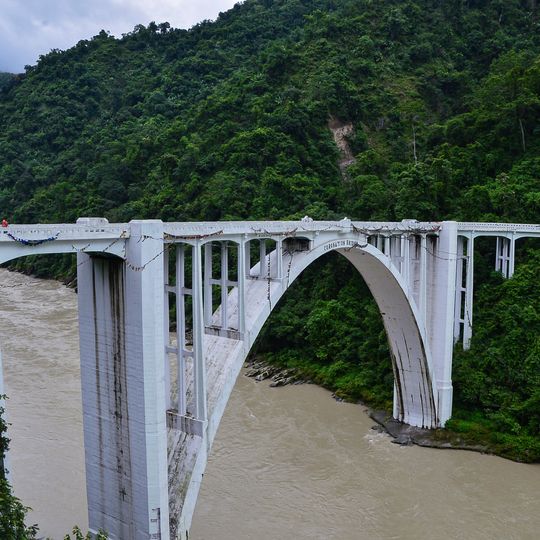
Coronation Bridge is a concrete arch bridge over the Teesta River in Darjeeling District, India, connecting two mountainous banks through a single wide arch. The construction rises about 26 meters (85 feet) above the water level and spans roughly 80 meters (260 feet), with the roadway designed for two lanes of traffic.
Construction began in the late 1930s and finished in 1941 to improve transport links through the Himalayan foothills during British colonial rule. Engineers used reinforced concrete, a relatively new technique in that region at the time, to span the river without intermediate piers in the riverbed.
Locals call the bridge Baghpool, meaning tiger bridge, after the two tiger statues at one entrance; the sources also note decorative lion statues at the Jalpaiguri entrance, often mistaken for tigers. The bridge stands near the Sevokeshwari Kali Mandir in Sevoke, making it a stop for pilgrims and tourists. It is one of India's few remaining spandrel-arch bridges, and local groups have campaigned for heritage status.
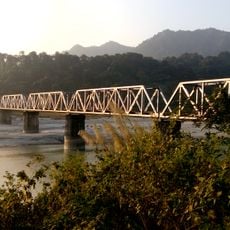
The bridge carries National Highway 17 (formerly NH 31) between Siliguri and the Darjeeling and Kalimpong districts. Since a 2020 inspection found a 2.5-foot crack in the arch, vehicles over 10 tons are restricted. The Sevoke Railway Bridge crosses the Teesta about 2 km away.
Locals call the bridge Baghpool, meaning tiger bridge, after the two tiger statues at one entrance; the marble plaques on the structure commemorate the architects and dignitaries involved. Three Bengali architects, A.C. Dutt, S.K. Ghosh and K.P. Roy, designed it under John Chambers of the Darjeeling PWD.
The community of curious travelers
AroundUs brings together thousands of curated places, local tips, and hidden gems, enriched daily by 93,012 contributors worldwide.