Sybaris, Archaeological site in Cassano allo Ionio, Italy.
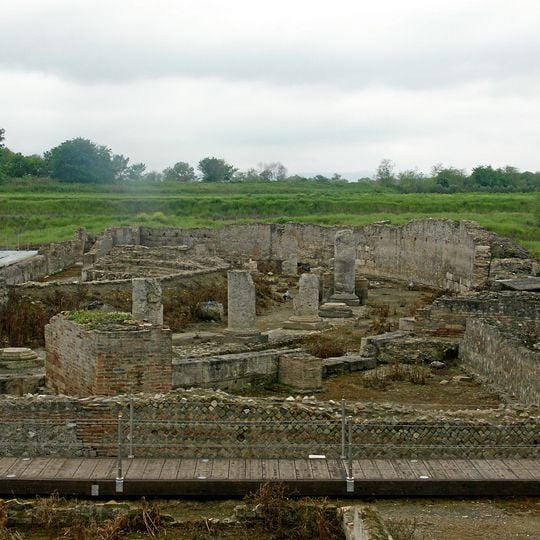
Sybaris is an excavated archaeological site near Sibari in Calabria, with low walls of reddish brick and grey stone outlining rectangular foundations. Pale, weathered stone pillar bases stand within the enclosure, and a metal rail fence runs along a wooden walkway in the foreground. The site museum displays two silver coins: one convex piece shows a bull with a curved horn and beaded border, the other is concave and pitted.
Greek settlers from Achaea and Troezen founded the city in 720 before Christ and developed it through agriculture and maritime trade into a wealthy commercial center. After its destruction, Thurii arose at the same location as an Athenian-backed colony, followed by the Roman settlement of Copiae.
The name Sybaris gave us the words "sybarite" and "sybaritic", used across Europe for luxury and pleasure-seeking. Ancient writers describe citizens like Smindyrides, whose entourage reportedly included a thousand slaves, cooks and bird-catchers, and who allegedly could not sleep on rose petals for the blisters. The city's silver coins, struck from about 530 BC, show a bull with its head turned back and the legend Sybaris.
The archaeological area divides into three zones: Parco del Cavallo, Casa Bianca and Stombi, each representing different settlement phases. Visitors should wear sturdy footwear as paths can be uneven and the tour leads through open-air terrain.
The silver coins of Sybaris were struck with a bull on the obverse and, on the reverse, the same bull sunk in negative, a technique called incuse. The city minted them from about 530 BC, and its dependent towns issued coins with the same bull and their own names.
The community of curious travelers
AroundUs brings together thousands of curated places, local tips, and hidden gems, enriched daily by 92,662 contributors worldwide.