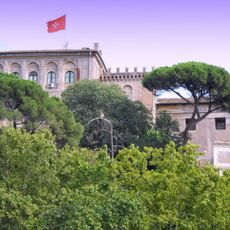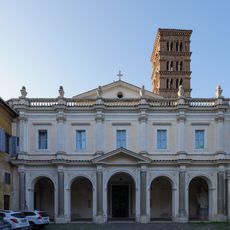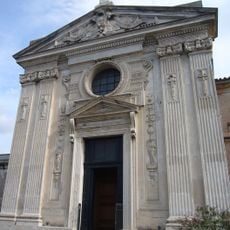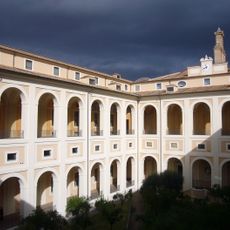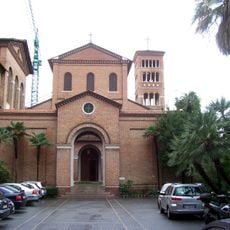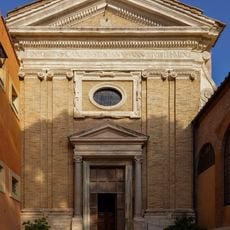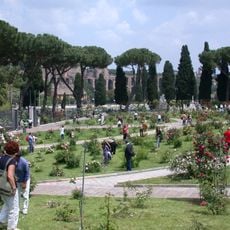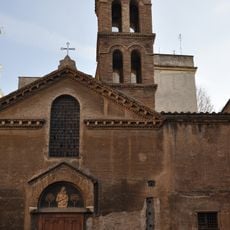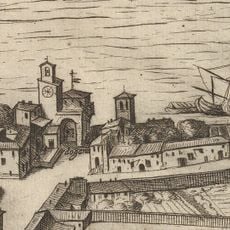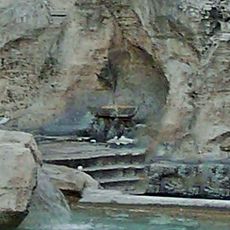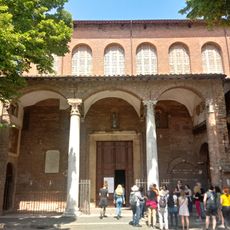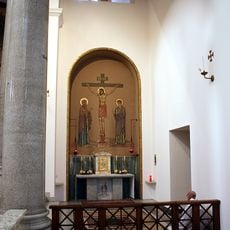
Basilica of Saint Sabina, Minor basilica on Aventine Hill, Rome, Italy.
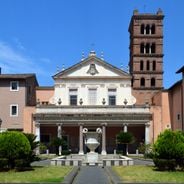
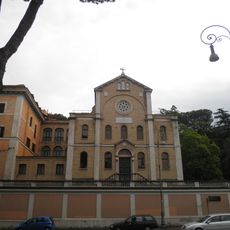
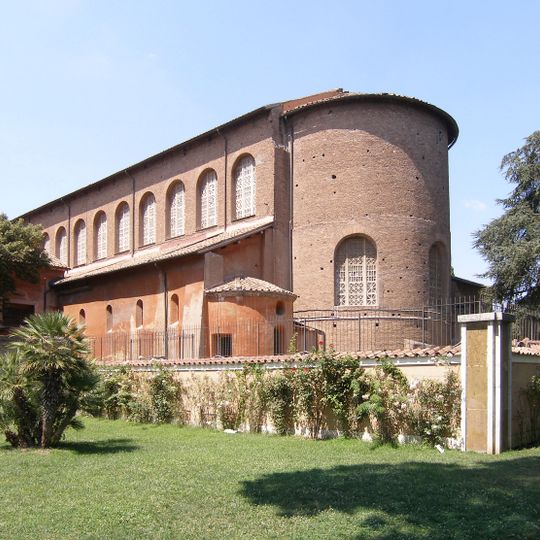
The Basilica of Saint Sabina is a brick church on the Aventine Hill. Its long side wall is divided by shallow pilasters into bays with tall arched windows, and a plain cylindrical drum with two large arched windows stands at one end. Inside, a flat coffered wooden ceiling covers a nave lined by two rows of smooth cylindrical columns with carved stone capitals, ending at a raised platform and a curved apse with a semi-circular mosaic on a gold ground.
Peter of Illyria, a Dalmatian priest, built the basilica between 422 and 432 on the Aventine, on the site of the house of the Roman matron Sabina. Pope Celestine I established the cardinal title of Santa Sabina in 423. In 1220 Honorius III invited Saint Dominic to reside here, and the property was legally transferred to the Order of Preachers on 5 June 1222. Domenico Fontana renovated the interior in 1587 and Francesco Borromini in 1643; Antonio Muñoz restored the medieval appearance in 1914–1919.
The name recalls Sabina, a Roman matron from Avezzano beheaded under Hadrian in AD 126 after her servant Serapia converted her; both are saints. In the cloister grows a bitter orange tree that Dominican tradition says Dominic planted in 1220, brought as a shoot from Spain and considered the oldest tree in Rome. A round black stone on a twisted column near the entrance is called the Lapis Diaboli.
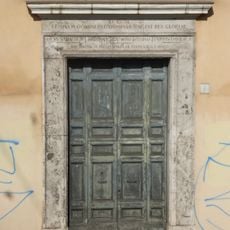
It is easiest to visit on foot from the Aventine, where the church sits on a quiet plaza. The large wooden doors at the entrance are clearly visible and the interior spaces are arranged on one level, making access straightforward.
The wooden doors date from the fifth century and display biblical scenes with impressive carved detail. These early artworks are among the rare surviving examples of Christian craftsmanship from that era.
The community of curious travelers
AroundUs brings together thousands of curated places, local tips, and hidden gems, enriched daily by 93,373 contributors worldwide.