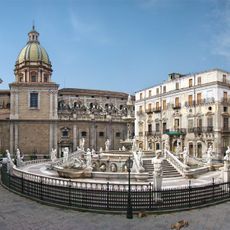
Martorana, Norman-Byzantine church in Palermo, Italy
The Martorana, or Santa Maria dell'Ammiraglio, is a church on Piazza Bellini with a 12th-century square bell tower that serves as its entrance, open below by arches on corner columns and pierced by three orders of large mullioned windows. Its plan is a Latin cross with a narthex and atrium; beyond the narthex stand pointed arches and the pendentives of the dome. The facade is of weathered tan and grey stone blocks, centred on a tall portal with a dark wooden double door in an arched frame, with two tall windows flanking it.
The church was founded in 1143 as a private chapel under King Roger II and emerged during a time when Sicily blended Norman and Byzantine influences. This period shaped the island's artistic and architectural development.
The parish belongs to the Italo-Albanian Catholic Church and celebrates the Byzantine Rite in Greek and Albanian for some 15,000 Arbëreshë faithful in Palermo. The name "dei Greci" referred to the rite, not to Greek ethnicity. The nuns of the adjoining convent made the marzipan fruits called Frutta di Martorana, still sold in Palermo pastry shops.
A visit requires only a short time since the interior is compact and focused on the mosaics. Visitors should arrive during early hours or outside peak times to examine the details calmly.
Two columns at the entrance carry Arabic inscriptions in Kufic script: one quotes Quran 16:128 (An-Nahl), the other is a basmala. A Christian inscription in Arabic, painted on wood, sits inside the dome's mosaic. The 1143 foundation charter, in Greek and Arabic, survives.
The community of curious travelers
AroundUs brings together thousands of curated places, local tips, and hidden gems, enriched daily by 94,048 contributors worldwide.