Palace of Monza, Royal residence and museum in Monza, Italy
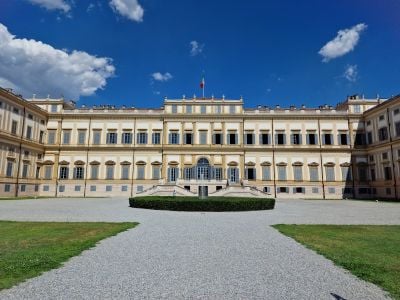
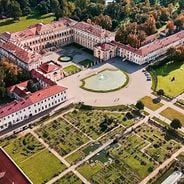
The Palace of Monza is a neoclassical palace designed by Giuseppe Piermarini, built between 1777 and 1780. Its inverted U-shaped plan, inspired by Schönbrunn, has a central body of two double-height floors plus a belvedere, while the side wings rise five floors. The complex covers 22,000 m² with 700 rooms.
Austrian Empress Maria Theresa commissioned the palace in 1777 as a summer residence for her son Archduke Ferdinand, and architect Giuseppe Piermarini completed it in 1780. The construction reflects the political importance of Lombardy within the Habsburg realm.
The name Villa Reale dates from 1805, when Viceroy Eugène de Beauharnais made the palace his main residence in the Napoleonic Kingdom of Italy. Luigi Canonica added a court theatre in the north wing for music, singing, dance and drama. Today the building hosts exhibitions, and one wing houses Monza's Nanni Valentini artistic high school.
The palace stands on the western edge of Monza, with its forecourt facing the city and the 14 km wall of Monza Park running behind it; the park entrances and the Porta Reale give direct walking access from the centre. The south wing is run by the state, the rest jointly by Monza, Milan and the Lombardy Region, so exhibition areas and the school wing keep separate hours. The Royal Station built in 1882 on the Monza–Chiasso line serves the palace side of the park.
The palace connects to Monza Park, which was enclosed during the Napoleonic era with a long wall to create one of Europe's largest walled gardens. This combination of building and garden offers visitors a vast, connected area to explore.
The community of curious travelers
AroundUs brings together thousands of curated places, local tips, and hidden gems, enriched daily by 93,357 contributors worldwide.