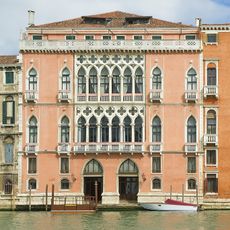
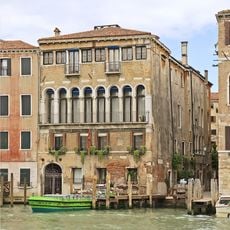
Ca Cappello, Renaissance palace on Grand Canal in San Polo, Italy.
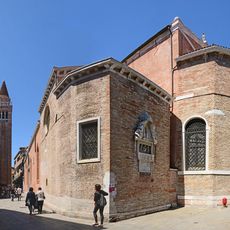
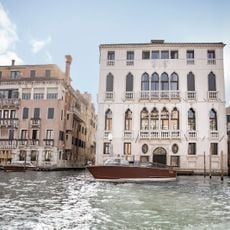
Ca Cappello is a Gothic-origin palace substantially rebuilt in the 16th century for Antonio Cappello. It has three facades: the wide Grand Canal front with many single lancet windows and a first-floor three-mullioned window opening onto a terrace beside Palazzo Grimani Marcello; the plain Rio delle Erbe side; and the Rio di San Polo side with two balconied three-mullioned windows and 19th-century stone paterae. A small courtyard lies at the centre.
Ca' Cappello is a Gothic-origin palace substantially restructured in the 16th century for the procurator of Saint Mark Antonio Cappello, who oversaw works on the Rialto bridge, the Biblioteca Marciana and the Scala d'Oro. He commissioned a fresco cycle by Giovanni Battista Zelotti and Paolo Veronese, already damaged by fire when described in 1674 and later lost. In the 1870s the palace was bought by Austen Henry Layard, discoverer of Nineveh, who restored it and housed his Renaissance painting collection.
The Layards' salon drew John Ruskin, Giovanni Morelli, Robert Browning and Countess Annina Morosini; Lady Enid Layard's diary records these visits. The couple's patronage helped fund St George's Anglican church in Venice, where windows commemorate its founder.
The building houses a university department today and is located about 300 meters from the nearest public transport stop, making it relatively easy to reach. Visitors should know that the structure sits directly on the water and pathways to entrances involve crossing bridges.
The palace sits at a rare intersection of three waterways, which required creating an unusual three-sided facade design. This location forced architects to arrange the interior in creative ways to make use of all three water-facing sides.
The community of curious travelers
AroundUs brings together thousands of curated places, local tips, and hidden gems, enriched daily by 93,806 contributors worldwide.