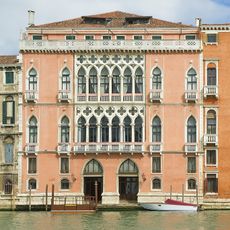
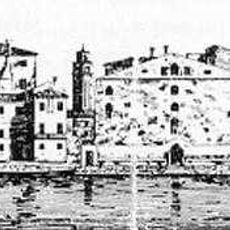
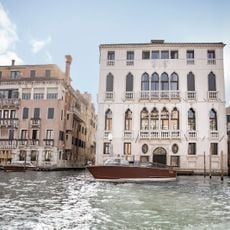
Palazzo Tiepolo, Renaissance palace in San Polo, Venice, Italy.
Palazzo Tiepolo is a 16th-century Renaissance palace on the Grand Canal in San Polo, between Palazzo Tiepolo Passi and Palazzo Pisani Moretta. Its four-storey facade has three string courses, twin arched doors and a central quadrifora with a balcony on each noble floor. Traces of frescoes by Andrea Schiavone remain on the exterior.
The palace was built in the second half of the 16th century for the Tiepolo family, on the site of an older building, possibly of Venetian-Byzantine origin; the architect is unknown. In the latter half of the 19th century the exiled Montenegrin princesses Darinka and her daughter Olga lived here permanently. Before World War I the German writer Franz Joseph von Bülow resided in the palace.
The palace takes its name from the Tiepolo family, who commissioned it in the second half of the 16th century. Inside, the portego, the central hall running through the building, is decorated with frescoes by Jacopo Guarana, while polychrome stuccoes cover the interior rooms. On the facade, traces of frescoes by Andrea Schiavone, known as lo Schiavone, remain visible but are in poor condition and await restoration.
The palace stands on the north bank of the Grand Canal in San Polo, between Palazzo Soranzo Pisani and Palazzo Pisani Moretta, and is seen from the vaporetto line 1 and 2 as they pass. There is no land entrance open to visitors; the water door opens onto the canal. View the facade from the opposite bank or from a passing boat.
In the second half of the 19th century the palace housed two exiled Montenegrin princesses, Darinka and her daughter Olga, who took up permanent residence there. Their stay is a lesser-known episode compared with the later tenancy of the German writer Franz Joseph von Bülow before World War I.
The community of curious travelers
AroundUs brings together thousands of curated places, local tips, and hidden gems, enriched daily by 94,449 contributors worldwide.