Pinciano obelisk, Ancient Egyptian obelisk at Pincian Hill, Rome, Italy
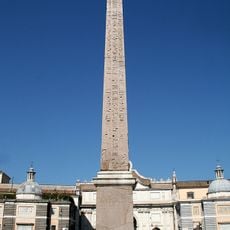
The Pinciano obelisk is a Roman obelisk of rose granite from Egypt, standing on the Pincio in Rome along Viale dell'Obelisco. The shaft is 9.24 metres high; with its base and the star on top it measures 17.26 metres. Hieroglyphs on all four sides recount the death and deification of Antinous and the founding of Antinoupolis.
The obelisk was commissioned in the 2nd century by Emperor Hadrian as a memorial dedicated to Antinous, a figure of great importance to the emperor. It formed part of Rome's practice of bringing Egyptian symbols to the city as displays of imperial power and cultural sophistication.
The hieroglyphs on all four sides were probably carved in Rome by an Egyptian priest, not in Egypt. They recount the death of Antinous, his deification beside the gods, the founding of Antinoupolis and the cult of Osiris-Antinous, and on the south side ask that Antinous be joined to Osiris for Hadrian's salvation.
The obelisk sits within Villa Borghese and can be reached by walking through the gardens toward Viale dell'Obelisco. It is easily accessible since it stands on open ground near the Piazza del Popolo entrance.
The hieroglyphs on all four sides were likely carved in Rome by an Egyptian priest, not in Egypt. Some Egyptologists, including Philippe Derchain and Jean-Claude Grenier, link the unusual titulary to a priest of Akhmim named Petarbeschenis, whose funerary stele bears a very similar text.
The community of curious travelers
AroundUs brings together thousands of curated places, local tips, and hidden gems, enriched daily by 93,375 contributors worldwide.