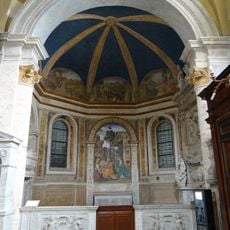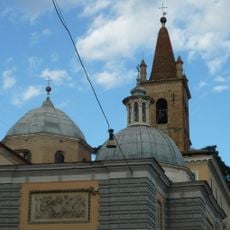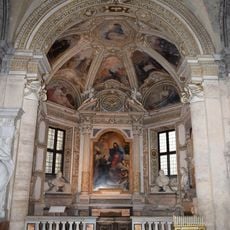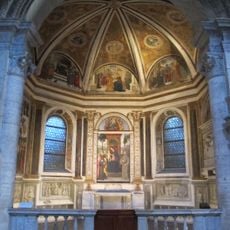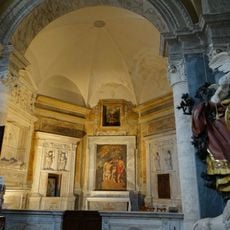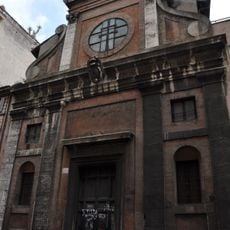
Cybo-Soderini Chapel, Baroque chapel in Santa Maria del Popolo, Rome, Italy.
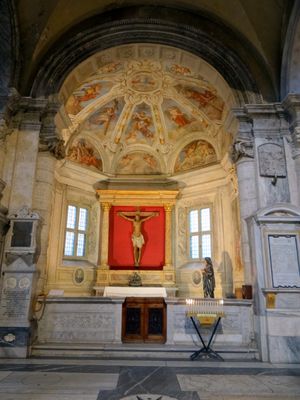
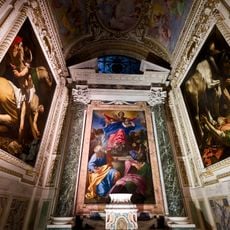
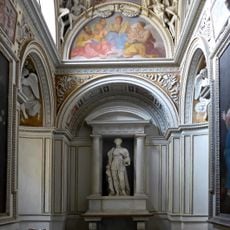
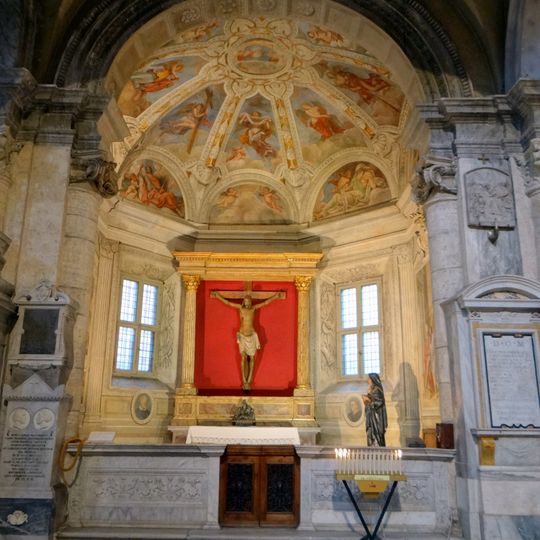
The Cybo-Soderini Chapel is a side chapel of Santa Maria del Popolo in Rome, entered through an arch with Ionic stucco capitals added after 1636. Its walls are articulated by painted Corinthian pilasters, and the vault and side walls carry Pieter van Lint's frescoes of the Legend of the True Cross, framed by stucco decorated with the Soderini coat of arms. A wooden crucifix stands above the altar in a 19th-century Corinthian aedicule.
Teodorina Cybo, natural daughter of Pope Innocent VIII, founded the chapel; her husband Gherardo Usodimare was buried here after his sudden death in 1499. First documented in 1530 as the Cappella del Crocifisso, it was fully restored in Baroque style after 1636 by Innocenzo Cybo, who added Pieter van Lint's frescoes. Count Lorenzo Soderini bought it in 1821 and restored it in 1825.
The chapel is also called the Chapel of the Crucifixion after the wooden crucifix above the altar, first recorded in 1530 as the imago Crucifixi. Tradition holds that St Philip Neri spent long hours praying before it, and Pope Gregory XIII granted privileges to the altar in 1576. The 1636 restoration was justified by the reverence the whole Roman people felt for the statue.
Access to the chapel comes through the basilica during regular hours, and visitors can view the interior details up close. Light changes throughout the day, so time the visit to see the artwork and decoration clearly.
The wooden crucifix above the altar was first recorded in 1530 as the imago Crucifixi. Tradition holds that St Philip Neri spent long hours praying before it, and Pope Gregory XIII granted privileges to the altar in 1576. The sculpture is poplar wood covered in canvas, stuccoed and painted; its arms and feet were replaced in 1922.
The community of curious travelers
AroundUs brings together thousands of curated places, local tips, and hidden gems, enriched daily by 93,081 contributors worldwide.