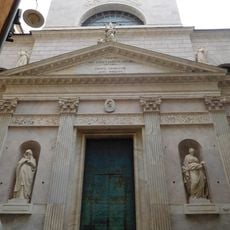
Palazzo Spinola di Pellicceria, Renaissance palace in historical center of Genoa, Italy.
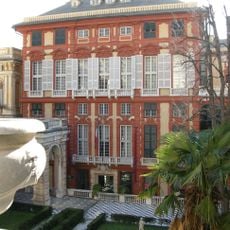
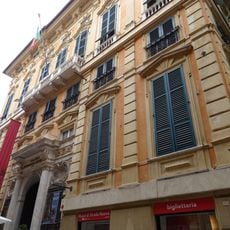
Palazzo Spinola di Pellicceria is a Renaissance building in Genoa's historic center, featuring a two-colored stone facade with marble statues set in decorative wall niches. The structure rises across multiple floors containing galleries, period rooms, and exhibition spaces where artwork is displayed throughout.
Francesco Grimaldi's will provided the funds, and construction began in 1593 on medieval foundations. The palace entered the Rolli, the register of residences where the Republic of Genoa lodged state visitors, and Rubens included its facade in his 1622 I Palazzi di Genova. In 1641 it passed to Ansaldo Pallavicini to settle a debt, then by inheritance to the Doria and, in the early 18th century, to the Spinola. Allied bombing in World War II destroyed the third floor, rebuilt after 1958, when the Spinola marquises donated the palace to the state.
The palace's name recalls the Spinola family, who acquired it through the 18th-century marriage of Maddalena Doria to Niccolò Spinola; she directed the Rococo refurbishment and commissioned the Gallery of Mirrors. Since 1958, when the marquises Paolo and Franco Spinola donated it with its furnishings to the state, it has housed the National Gallery, opened in 1993.
The palace stands at piazza di Pellicceria 1, and it keeps its old entrance on the lower piazza di Pellicceria. An elevator was installed in the inner courtyard when the building was adapted for the gallery, so the exhibition floors can be reached without the staircases.
The building's facade was recorded in a print by Peter Paul Rubens, who featured it in his 1622 book on Genoese architecture. The image preserves how the front appeared in the early 1600s and shows why European art circles considered it worthy of documentation.
The community of curious travelers
AroundUs brings together thousands of curated places, local tips, and hidden gems, enriched daily by 94,226 contributors worldwide.