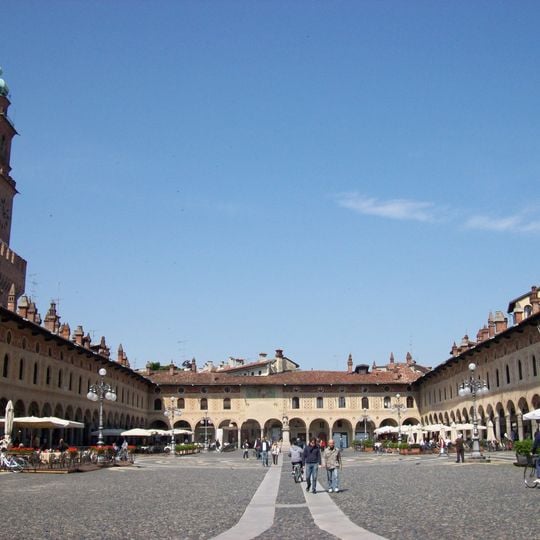
Piazza Ducale, Renaissance square in Vigevano, Italy
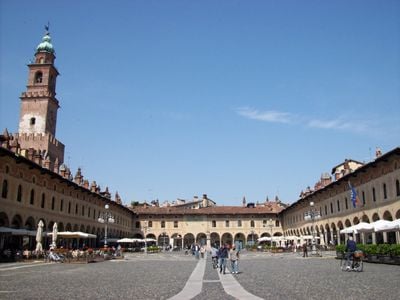
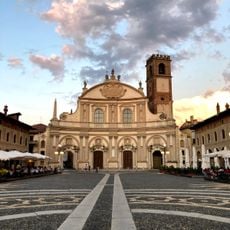
Piazza Ducale is a 134-metre-long and 48-metre-wide square in Vigevano, enclosed on three sides by continuous arcaded buildings of pale tan stone or stucco. The long central building has a ground-level arcade of rounded arches, two rows of small rectangular windows above, and a low-pitched roof of reddish-brown tiles; a slightly projecting central bay carries a clock and a small pediment. The left and right wings repeat the arcade and windows toward far corners, and the fourth side is occupied by the Cathedral of Sant'Ambrogio.
Ludovico Sforza announced the rebuilding of the Piazza dei Mercanti on 3 May 1492, and the new square was finished by 1494 under the engineer Ambrogio Ferrari, with Bramante's involvement inferred from style alone. The old houses and the Podestà palace were demolished, and 84 columns with individually carved capitals supported the arcades. In 1680 Bishop Juan Caramuel y Lobkowitz removed the castle ramp and added the concave cathedral facade, turning the square toward the church.
Ludovico Sforza had the old houses and the Podestà palace demolished from 1492 so the square could serve as an antechamber to his castle, and the communal palace was reduced to a minor position along the side. The 84 columns of the arcades carry capitals that are each different, and roundels above them hold busts of Roman figures and of the Visconti and Sforza dukes with mottoes. The square is still the main meeting point of Vigevano and holds shops and the stop of the city tourist train.
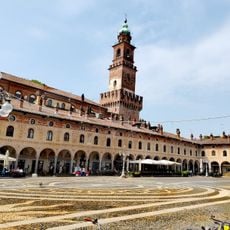
The square is the main access to the Castello Sforzesco; from its south-west corner a gallery leads to the castle, whose courtyard stands 7 metres higher. The brick tower built by Bramante can be climbed to the top for a view over the whole town. The paving of white and black granite slabs comes from the Ticino river, and the cast-iron lamps date from 1911.
The 84 columns of the arcades each carry a different capital, and above them roundels once held busts of Roman emperors, Visconti and Sforza rulers with mottoes. The candelabra-shaped half-columns around the upper windows follow a motif of Giovanni Antonio Amadeo, used at the Certosa di Pavia. Look for the surviving Sforza fresco fragments, uncovered between 1903 and 1910 beneath 17th-century paint.
The community of curious travelers
AroundUs brings together thousands of curated places, local tips, and hidden gems, enriched daily by 93,379 contributors worldwide.