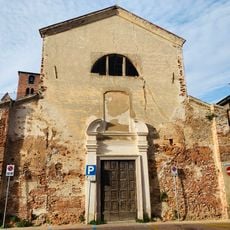
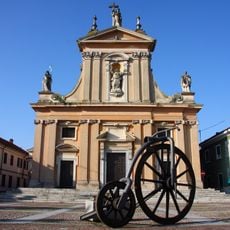
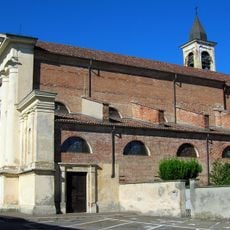
Abbey of Sant'Albino, Church-abbey in Mortara, Italy
The Abbey of Sant'Albino is a church-monastery complex in Mortara with a small single-nave church preceded by a columned portico added in 1540. A sturdy Romanesque bell tower stands beside it, and the semicircular apse is Romanesque, while the facade and nave show Renaissance work. Next to the church are the ruins of a cloister, a brick open gallery with wooden architraves and a 14th-century Gothic window with terracotta motifs.
The abbey traces its origin to a 5th-century church, Sant'Eusebio. In 774 the abbot Alkwin Albin added a canonical college, and the church became a stop for pilgrims heading south to Rome. Charlemagne reportedly founded it to bury soldiers fallen at the 773 battle of Pulchra Silva, including the paladins Amicus and Amelius. The monastery declined from 1290; in 1458–1462 Pius II turned its goods into a commendam.
The name comes from Saint Albinus of Angers, to whom the monastery was dedicated by pupils of Bishop Albinus Alcuin. In 1458 Paolo da Caylina painted a polyptych of the Virgin with Saints Lawrence, Albinus, Amicus and Amelius, held in Turin's Galleria Sabauda since 1840. Near the portal, two medallions recall the paladins Amicus and Amelius.
The abbey stands on the Via Francigena in the Mortara countryside, next to a farmstead, not in the town centre. The church is a small single-nave building entered through a 1540 columned portico; the Romanesque bell tower and the ruins of the cloister with a 14th-century Gothic window are outside. The interior was restored around the Jubilee of 2000.
Medieval visitors carved their names into the abbey's brick walls, and these scratches date back at least to the year 1100. These hand-made marks show directly that pilgrims and travelers visited this holy site across the centuries.
The community of curious travelers
AroundUs brings together thousands of curated places, local tips, and hidden gems, enriched daily by 93,486 contributors worldwide.