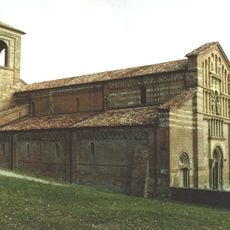
Abbazia di Santa Fede, Romanesque church in Cavagnolo, Italy
The Abbazia di Santa Fede stands near Cavagnolo with a three-nave basilical plan, the central nave wider and taller than the aisles and divided into six bays. Its facade of red brick and golden sandstone carries a projecting portal with carved archivolts, a carved tympanum showing Christ in a mandorla, and two facing griffins. A late brick upper section with sloping hanging arches rises above the arcades.
No foundation document survives; the sandstone block on the facade reads "XI KE NOVEMBRIS OB/ ROLANDUS PR" without settling the question. Scholars place construction around the mid-12th century, as a daughter house of the Benedictine abbey of Sainte-Foy-de-Conques in Auvergne, itself founded on an 8th-century Lombard monastic site. A 1372 testament of Giovanni II of Monferrato confirms the priory at Cavagnolo was still subject to Conques.
The church is dedicated to Saint Foy of Agen, a young French virgin martyred under Diocletian in 303 and celebrated on 6 October. Its capitals carry floral and zoomorphic carvings, and the left portal capital shows human figures entwined with vines, read by some as the struggle of vices and virtues. Above the two capitals crouch two facing animals.
The building is straightforward to explore from the outside, as the rich decoration of the facade is clearly visible and the interior is typically open to visitors. When entering, allow time to carefully examine both the outer details and the inner structures.
On the facade, a sandstone block bears the inscription "XI KE NOVEMBRIS OB/ ROLANDUS PR", which has never been explained and gives no help in dating the church. Above the portal, two crouching animals face each other on the capitals, and the outer arch carries a palm-leaf cross, emblem of the Benedictine branch of Cluny.
The community of curious travelers
AroundUs brings together thousands of curated places, local tips, and hidden gems, enriched daily by 94,536 contributors worldwide.