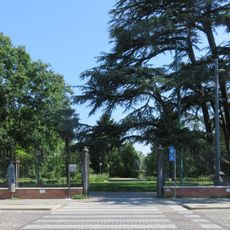
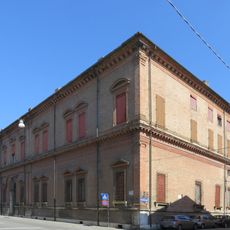
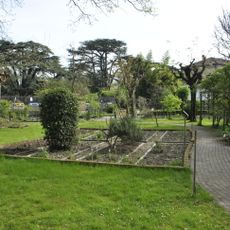
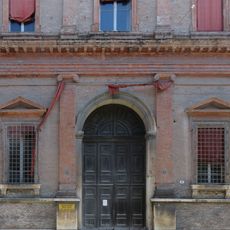
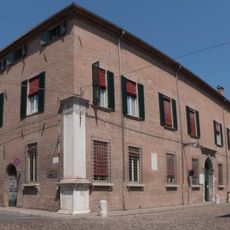
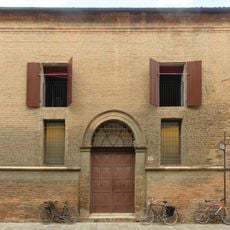
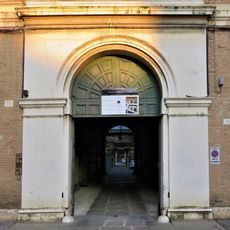
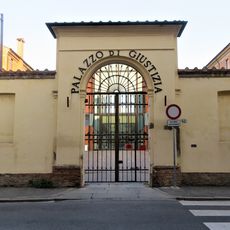
Addizione Erculea, Renaissance urban development in Ferrara, Italy.
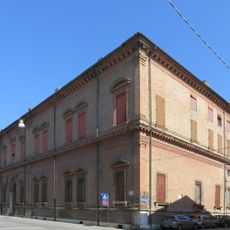
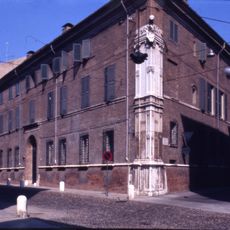
The Addizione Erculea is the northern half of walled Ferrara, added from 1492 by Duke Ercole I d'Este with plans by court architect Biagio Rossetti. Its two straight axes cross at the Quadrivio degli Angeli: corso Ercole I d'Este runs south to the Castello Estense, while corso Porta Po, corso Biagio Rossetti and corso Porta Mare run east to west. The old moat became corso Giovecca, and brick palaces such as Palazzo dei Diamanti line the grid.
Begun in 1484 after a Venetian siege and built between 1492 and 1510, the addition was commissioned by Ercole I d'Este from court architect Biagio Rossetti. It more than doubled the walled city north of the Castello Estense, whose moat was filled to form today's Corso Giovecca. The Barco bastion is among the earliest examples of modern fortification.
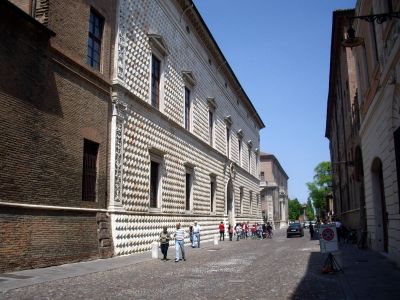
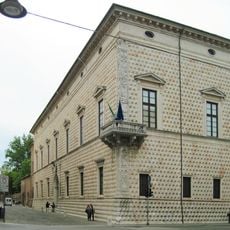
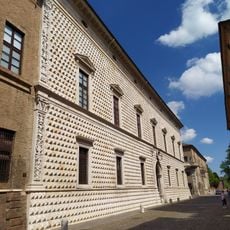
The neighborhood centers on the Palazzo dei Diamanti, whose facade consists of about 8,500 marble blocks arranged in a three-dimensional diamond pattern. This unusual surface treatment makes the building instantly recognizable and visually distinct from other Renaissance structures in the city.
The two main axes are Corso Ercole I d'Este, running north from the Castello Estense to the Porta degli Angeli, and the east-west line formed by Corso Porta Po, Corso Biagio Rossetti and Corso Porta Mare. The Quadrivio degli Angeli, where they cross, is the natural starting point. About 9 of the original 13 km of walls remain, mainly north and east.
This neighborhood is recognized as one of Europe's earliest examples of geometric city planning, with a layout that influenced later modern cities. The combination of wide streets, fortifications, and public squares was exceptionally forward-thinking for its time.
The community of curious travelers
AroundUs brings together thousands of curated places, local tips, and hidden gems, enriched daily by 93,070 contributors worldwide.