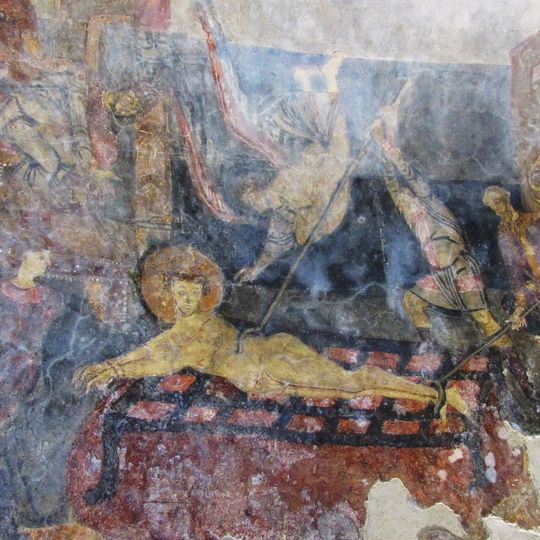
Epifanio Crypt, 9th century frescoes in San Vincenzo al Volturno Old Abbey, Castel San Vincenzo, Italy
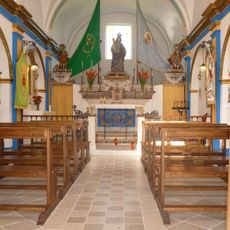
The Epifanio Crypt is the small church of Santa Maria in Insula, built by abbot-bishop Epifanio (824–842) within the San Vincenzo Minore complex at Castel San Vincenzo. It has a raised rectangular body ending in a tall triangular presbytery with the altar; its lost floor lay partly underground and connected to the semi-buried refectory area of San Vincenzo Maggiore. The walls carry a fresco cycle of the second quarter of the 9th century, with a continuous field of poppies linking the scenes.
The frescoes were painted in the second quarter of the 9th century by anonymous artists of the Beneventan miniature school. They decorate the small church of Santa Maria in Insula, built as a burial chamber by Abbot Bishop Epifanio, who governed San Vincenzo from 824 to 842. The first survey of the crypt was made in 1885 by Oderisio Piscicelli-Taeggi, a monk of Montecassino.
The painted scenes show key moments of Christian faith such as the Annunciation, Nativity, and Crucifixion that held deep meaning for worshippers then and now. These images served to teach biblical stories to people who could not read.
The space is located beneath the abbey church and is accessible to visitors who want to see how early medieval religious artwork appeared. The preserved paintings allow you to observe the painting techniques and artistic style of the period firsthand.
The crypt was originally a small church dedicated to Santa Maria in Insula, built under Abbot Epifanio, who governed San Vincenzo from 824 to 842. A field of poppies painted without interruption links all the scenes, a motif of eastern origin read as a sign of death and rebirth, and thus of the Resurrection.
The community of curious travelers
AroundUs brings together thousands of curated places, local tips, and hidden gems, enriched daily by 93,849 contributors worldwide.