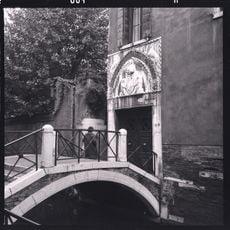
San Cassiano, Catholic church in San Polo, Venice, Italy.
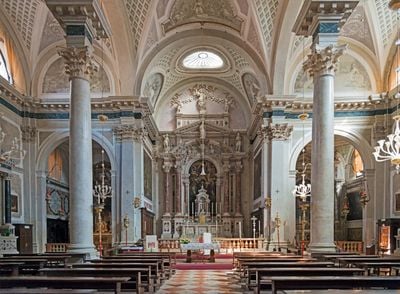
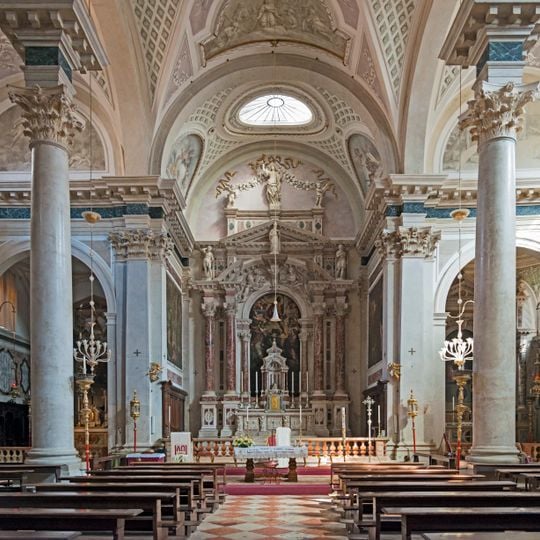
San Cassiano is a 14th-century church in San Polo, consecrated in 1376 and remodelled to its present form in 1663. Its tall hall rises to a barrel-vaulted ceiling painted by Costantino Cedini, with pale grey and blue-grey figures and framed panels. At the far end, a stone altar wall by Heinrich Meyring and Nardo stands between two grey-veined marble columns, with reddish marble columns framing a niche and domed tabernacle; wooden benches sit on a red-and-white checkered floor.
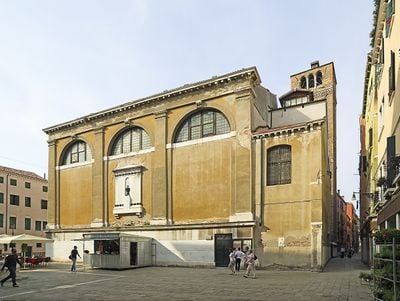
A church existed here by 726, when it was dedicated to Saint Cecilia; it was rebuilt after a fire in 1106 and again from 1350, being consecrated in 1376 to Saint Cassian of Imola. The interior was remodelled in the early 17th century, giving the building its present appearance, dated 1663. The 43-metre brick campanile dates from the 13th century, with a Gothic belfry added soon after.
The campo takes its name from the church and held the Teatro San Cassiano, the first public opera house, which opened in 1637. The church keeps an early 18th-century Martyrdom of San Cassiano by Antonio Balestra, showing the saint attacked by schoolchildren; that scene explains why Cassian of Imola is the patron saint of schoolteachers.
The church is typically open only in the mornings, usually Tuesday through Saturday, so plan your visit accordingly. Since it remains an active place of worship, occasional closures may occur, making it wise to check current opening times before arriving.
A Tintoretto painting of the Crucifixion from the 16th century was praised by art critic John Ruskin as one of the finest examples of this subject in European art. This endorsement by an influential art theorist helped establish the painting's international reputation.
The community of curious travelers
AroundUs brings together thousands of curated places, local tips, and hidden gems, enriched daily by 93,962 contributors worldwide.