Basilica di San Prospero, Renaissance basilica in central Reggio Emilia, Italy.
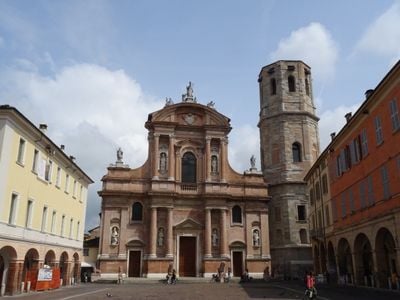
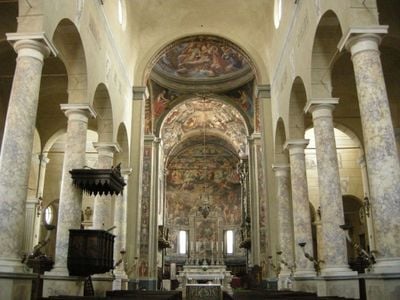
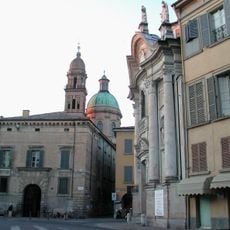
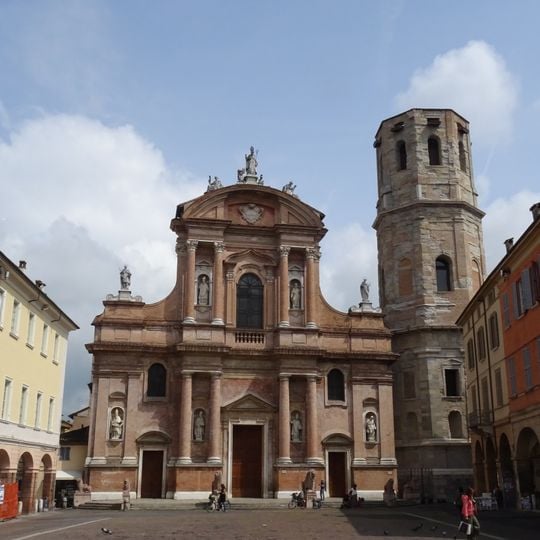
The Basilica di San Prospero is a Renaissance church on Piazza San Prospero in central Reggio Emilia, built in a Latin cross with three naves. Its late Baroque facade by Giovanni Battista Cattani, added in 1748–1753, carries eleven statues of saints and doctors of the Church. To its right stands the unfinished octagonal bell tower designed by Cristoforo Ricci and revised by Giulio Romano. Inside, smooth grey-brown marble columns with carved capitals line the nave, whose barrel vault is painted with frescoes by Camillo Procaccini.
A church called San Prospero di Castello stood inside the walls before 997, when Pope Gregory V consecrated it; Bishop Teuzone had it built during his episcopate. In 1514 the ruined church was demolished for the expansion of the city walls, and the new building by Luca Corti and Matteo Florentino was finished in 1527, with the minor chapels completed and the basilica reconsecrated in 1543. The octagonal bell tower was rebuilt between 1536 and 1570 to designs by Cristoforo Ricci and Giulio Romano, and the facade was added by Giovanni Battista Cattani in 1748–1753.
The name of the basilica comes from San Prospero, the fifth-century bishop credited with saving Reggio from Attila's Huns by wrapping the town in fog. The carved wooden choir of 1545 by Cristoforo da Venezia and his son Giuseppe stands in the presbytery; its lower stalls may hold inlays from the earlier choir of Cristoforo and Lorenzo da Lendinara (1457–1461).
The basilica faces Piazza San Prospero in the historic centre, a short walk from the cathedral and the Sala del Tricolore. The six red Verona marble lions stand on the paved churchyard in front of the facade, where local children often climb on them. The octagonal bell tower rises to the right of the facade and remains unfinished.
Six rose-coloured Verona marble lions (1503) stand at the edge of the churchyard, carved for a portico of three porches that was never finished. Tradition attributes them to Gaspare Bigi, though some scholars place the archaic figures earlier, in the Romanesque period; only the bases are certainly his, and one bears the profile of Girolamo Pratonieri, who financed the rebuilding. Generations of Reggio children have climbed on their backs.
The community of curious travelers
AroundUs brings together thousands of curated places, local tips, and hidden gems, enriched daily by 92,846 contributors worldwide.