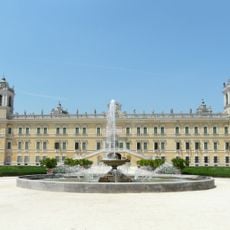
San Liborio, Neoclassical church in Colorno, Italy
San Liborio is a Neoclassical church on Via Roma in Colorno, behind the Ducal Palace. Its orientation was reversed in 1788, so the entrance now faces the street and the apse the former palace courtyard. Inside, a Latin-cross plan with three naves is flanked by four chapels per side, and the decoration was carried out by ducal artists including Domenico Muzzi and Benigno Bossi.
Francesco Farnese built the first palatine chapel here around 1722, probably to a design by Giuliano Mozzani, and dedicated it to Saint Liborius because the duke suffered from kidney stones. It was damaged in the 1734 Battle of Colorno. Ferdinando di Borbone had the Baroque chapel demolished in early 1775; the first stone of the Neoclassical replacement was laid on 16 May 1775 and the church was consecrated on 16 October 1777 by Alessandro Garimberti, bishop of Borgo San Donnino. The design, perhaps by Gaspare Turbini, drew on Ennemond Alexandre Petitot's 1754 projects.
The church remains an important landmark for the town community and demonstrates how religious buildings were designed during the 18th century. Visitors can observe how the clean proportions and balanced layout shape the interior experience and convey the architectural preferences of that era.
The church is located near the Ducal Palace of Colorno in the town center and is easy to reach. Its central position makes it convenient to visit while exploring the surrounding area on foot.
The chapel owes its dedication to San Liborio, protector of sufferers of kidney stones, because Duke Francesco Farnese, who commissioned it around 1722, suffered from that illness. The original Baroque oratory was damaged in 1734 during the Battle of Colorno.
The community of curious travelers
AroundUs brings together thousands of curated places, local tips, and hidden gems, enriched daily by 94,362 contributors worldwide.