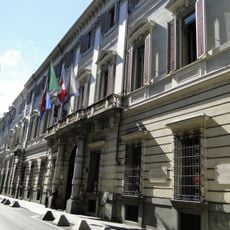
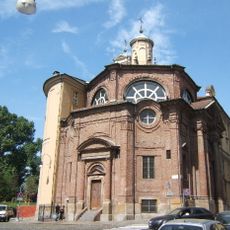
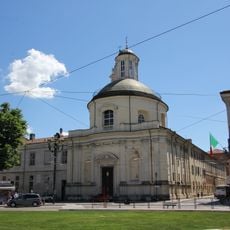
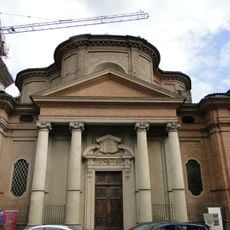
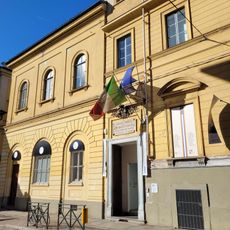
Santissima Annunziata, Baroque church in Via Po, Turin, Italy.
The Santissima Annunziata on Via Po is a 20th-century reconstruction in Roman Baroque style, moved west of its original site to open Via Sant'Ottavio. Its facade, completed in 1776 by Francesco Martinez, was later given porticoes in the 19th century. Inside are the original artworks: Bernardo Vittone's high altar and the wooden processional machine designed by Beaumont and carved by Giuseppe and Stefano Maria Clemente.
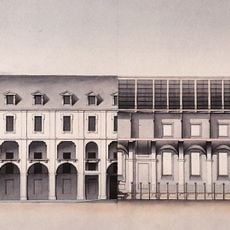
Built between 1648 and 1656 to a design by Carlo Morello for the Confraternita della Santissima Annunziata, the church stood on Via Po, the axis of Turin's new expansion. It was enlarged in 1693 with a longer choir and two side chapels, and its facade was finished only in 1776 by Francesco Martinez, with porticoes added in the 19th century. Judged unsound and too small, it was demolished in 1913 and rebuilt by engineer Giuseppe Gallo between 1919 and 1934, shifted west to open Via Sant'Ottavio.
The church is named for the Annunciation and was built for the Confraternita della Santissima Annunziata. Inside are the main altar by Bernardo Vittone, a wooden processional machine designed by Beaumont and made by Giuseppe and Stefano Maria Clemente, and the altar and balustrade of the Addolorata chapel by Francesco Martinez, nephew of Simone Martinez.
The church is generally accessible to visitors most days, though hours may vary depending on religious services. It is best to avoid entering during Mass times to respect those worshipping.
The present church is not in its original spot: it was shifted west when rebuilt (1919-1934) to open Via Sant'Ottavio. The 1913 decision to demolish followed the building's poor condition and its inadequacy for the confraternity's community. The Roman-baroque design is by engineer Giuseppe Gallo.
The community of curious travelers
AroundUs brings together thousands of curated places, local tips, and hidden gems, enriched daily by 93,036 contributors worldwide.