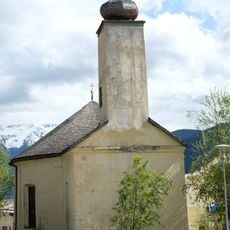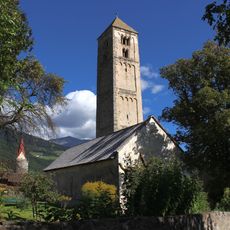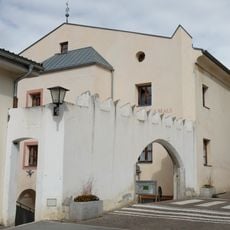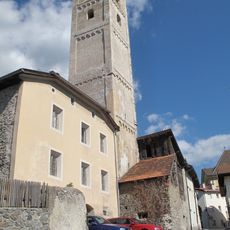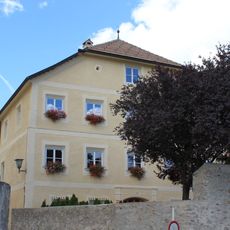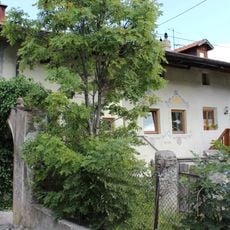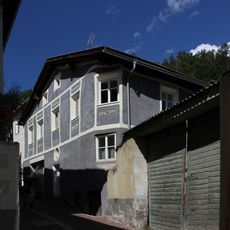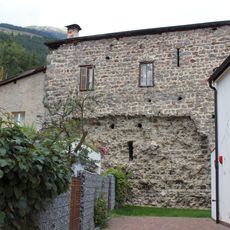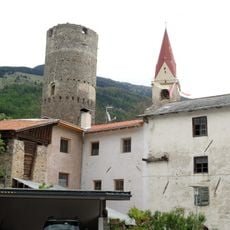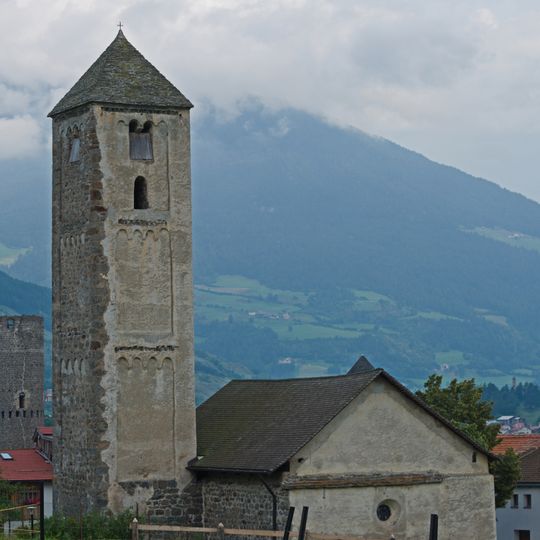
St. Benedict, Pre-Romanesque church in Mals, South Tyrol, Italy.
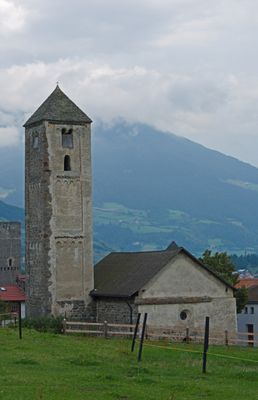
St. Benedict is a pre-Romanesque church in Mals, South Tyrol, built as a simple rectangular hall with a square bell tower added on its north side in the 12th century. The tower has three storeys, round-arched openings and a low pyramidal roof. The east wall holds three round-arched slit windows behind which lie three altar niches with traces of original stucco sculpture.
Built in the second half of the 8th century as a proprietary church, St. Benedict belonged to the Bishop of Chur until the 12th century, when the nave was encased and the Romanesque bell tower added. Profaned under Joseph II, it served as a storeroom until its Carolingian frescoes were rediscovered in the early 20th century.
The name St. Benedict comes from the Benedictine nuns who owned the church from 1165; its original dedication is unknown. The frescoes, painted around 800, show Pope Gregory the Great writing his Dialogues and disputing with Paulus Diaconus, alongside scenes from the life of Paul of Tarsus and a fragment of a Benedict legend. The donor portraits include a noble Frankish landowner, the only known depiction of a Frankish lord in traditional dress in Europe.
St. Benedict stands in the Mals district of Fröhlichsburg, its tower attached to the north side of the nave. The west wall keeps a bricked-up round-arched door with a round window above it, while the south side has a round-arched door and two round-arched windows. Three slit-like arched windows open onto the altar wall in the east.
The Carolingian fresco of around 800 was used as the logo of a 2002 Vienna conference on medieval history and culture, and as the cover image of Susan Wood's 2009 Oxford monograph on the early medieval European church.
The community of curious travelers
AroundUs brings together thousands of curated places, local tips, and hidden gems, enriched daily by 92,619 contributors worldwide.