Sant’Agnese Church, Gothic church in Lodi, Italy
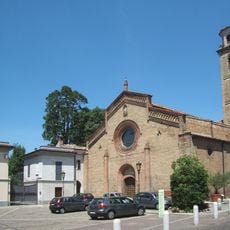
Sant'Agnese Church is a Gothic church in Lodi with a facade resembling that of the cathedral: strong vertical lines, two pointed single-light windows resting on a band of interwoven arches, and acroterion pinnacles on the gable. The interior is a hall church with three naves of equal height, cross vaults on cylindrical brick pillars, and a polygonal apse. The bell tower and apse are visible only from the cloister.
The church was built from 1351 within the monastery of the Augustinians, an order devoted to study and close to the papacy. Expansion was pushed forward from 1393 by the Augustinian Bonifacio Bottigella, bishop of Lodi until 1404, in the purest phase of Lombard Gothic. After the Cisalpine Republic suppressed the order on 23 June 1798, the church became subsidiary to San Lorenzo.
The name comes from Saint Agnes, shown with the martyr's palm and a lamb in the Galliani Polyptych. The church belonged to the Augustinians, whose rule appears on the open book held by Saint Augustine in the same polyptych: "Ante omnia fratres carissimi diligatur Deus deinde proximus". The wooden crucifix in the apse dates from the 15th century.
The polygonal apse and the two-tiered bell tower, which houses three bells cast by the Barigozzi brothers of Milan, can only be seen from the cloister. The lunette fresco of Saint Agnes on the facade is a late 19th-century remake. The organ above the entrance portal was built by Carlo Bossi of Bergamo in 1834.
The two-tiered bell tower, visible only from the cloister, holds three bells cast by the Barigozzi brothers of Milan in B-flat major; their shape is called ultraleggera. The polygonal apse can also be seen only from the cloister.
The community of curious travelers
AroundUs brings together thousands of curated places, local tips, and hidden gems, enriched daily by 93,680 contributors worldwide.