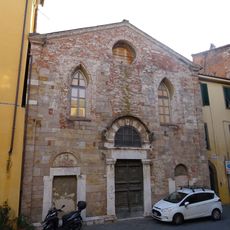
Sant'Alessandro, Lucca, Romanesque church in Lucca, Italy
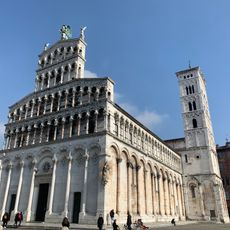
Sant'Alessandro Maggiore is a basilica-plan church in Lucca, first documented in 893 and considered the prototype of Lucchese Romanesque architecture. Its facade and sides are clad in perfectly polished white limestone slabs laid in alternating high and low bands, a scheme derived from Roman opus quadratum pseudoisodomum. The lower half of the facade, the first stretch of the flanks and the first six interior arches belong to an older church embedded in the present building.
First documented in 893, the church was rebuilt probably in the mid-11th century. In 1057-58 Bishop Anselmo da Baggio acquired the building and translated the relics of Saint Alexander into it. The apse decoration suggests work concluded in the first half of the 12th century, and the present church incorporates structures of an older building whose date remains debated.
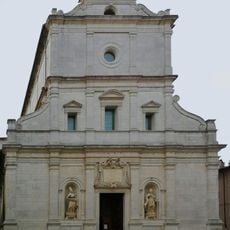
The church is dedicated to Saint Alexander, whose relics Bishop Anselmo da Baggio had transferred here in 1057–58, raising the building's standing. The facade's polished white limestone bands and the carved portal are the details to look at; the interior arcades use white and coloured stones set in symmetrical patterns.
The church is located in the historic center and is easily reached on foot from most of Lucca's main attractions. Be prepared for uneven flooring inside and note that access may be limited during religious services.
The facade's lower half, the first stretch of the flanks and the first six interior arches belong to an older church whose date is still debated; its stonework is close in quality to Roman architecture. Around the portal, twelve large slabs form a hexagon and seem to radiate from it, their proportions set by a double equilateral triangle.
The community of curious travelers
AroundUs brings together thousands of curated places, local tips, and hidden gems, enriched daily by 93,035 contributors worldwide.