Church of Santa Maria Assunta, Renaissance church building in Esine, Italy.
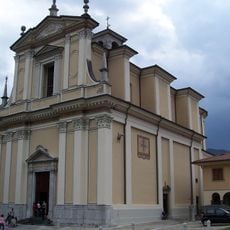
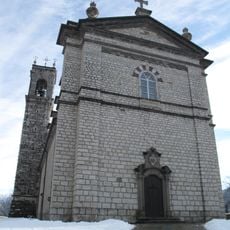
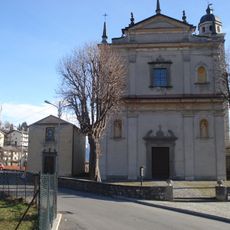
The Church of Santa Maria Assunta stands slightly above street level in north-west Esine, preceded by a cobbled forecourt. Its 1776 facade is divided into two orders by four pilasters with Tuscan capitals; the upper order has a central window and ends in a triangular pediment topped by three pinnacles. Inside, a single nave with a wooden roof leads to a presbytery covered by a cross vault.
Possibly Esine's first place of worship, it may date to the 6th or 7th century. A radical rebuilding ran until 1485, and in 1491-93 Giovanni Pietro da Cemmo frescoed the nave and presbytery for the Federici and Beccagutti families and rector Isacco de Favis. The 1776 facade replaced an earlier gabled one with a round window; the dispute with San Paolo ended with the 10 February 1710 ruling.
The name Santa Maria Assunta refers to the Assumption of Mary, the parish's principal feast. Until 1710 the church was the seat of a dispute with San Paolo over parochial rights; the bishop's delegate ruled that palm branches be distributed here on Palm Sunday. The Rosary chapel, built from 1573, held a Madonna statue later moved to San Paolo.
The church stands slightly above street level, reached across a cobbled forecourt, with the entrance in the centre of the 1776 facade. Inside, the single nave is covered by a wooden roof, while the presbytery has a masonry vault; the wrought-iron screen separating nave from presbytery was installed after Cardinal Borromeo's 1580 visit. The frescoes by Giovanni Pietro da Cemmo cover both nave and presbytery.
The 1573 Chapel of the Rosary was built by knocking down a section of wall, which destroyed a fresco probably showing the Last Judgement. The chapel's benefice survived Napoleon's suppression, but devotion declined through the 19th century and the Madonna statue was moved to San Paolo.
The community of curious travelers
AroundUs brings together thousands of curated places, local tips, and hidden gems, enriched daily by 94,672 contributors worldwide.