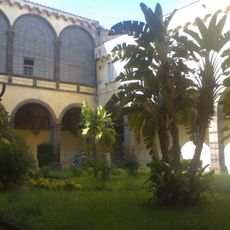
Chiostro di Santa Patrizia, Religious cloister in Naples, Italy
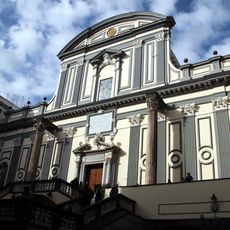
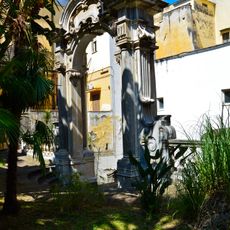
The Chiostro di Santa Patrizia is a cloistered complex on Via Luciano Armanni made of two connected courtyards. The larger cloister has a square plan whose arcades were altered in the 19th century for anatomy and pathology laboratories, and its frescoes of the life of Christ and of the titular saint were whitewashed; traces survive on the vault of the corridor to the old nuns' chapel. The smaller cloister keeps its original layout around a planted garden.
The monastic complex was founded in the 13th century for Basilian monks and later passed to Benedictine nuns, under whom it became one of Naples' richest and most influential monasteries. It remained active in that role until 1648, when slow logistical changes began. After Italian unification and the 1866 laws suppressing ecclesiastical property, the state and academics converted it into a centre for medical research, near the Incurabili and Gesù e Maria hospitals.
The complex is named after Saint Patricia, whose relics and veneration were tied to the Benedictine nuns who ran the monastery until 1648. The access street is dedicated to Luciano Armanni, the pathologist who directed the institute and founded a school of autopsy research here. Commemorative plaques in the historic halls carry the names of the anatomists who taught in rooms converted from the nuns' cells.
The complex stands on Via Luciano Armanni, the street named after the pathologist Luciano Armanni (1839-1903), who directed the pathological anatomy institute here. The smaller cloister, with its central tree-lined garden, kept its original layout and is the part still open to visitors; the larger square cloister was heavily altered for the anatomy and pathology laboratories.
The well at the centre of the main cloister is tied to a Neapolitan legend: the Byzantine general Belisarius, unable to take Naples by force, is said to have entered the city in 536 through this shaft, which connected to the underground aqueduct. The cloister's frescoes, whitewashed during the 19th-century conversion, survive only on the vault of the corridor to the old nuns' chapel.
The community of curious travelers
AroundUs brings together thousands of curated places, local tips, and hidden gems, enriched daily by 93,123 contributors worldwide.