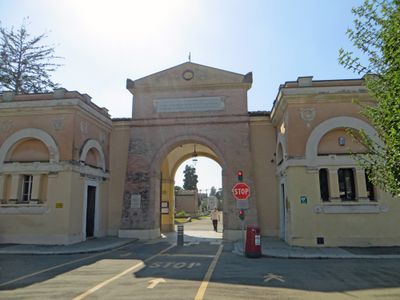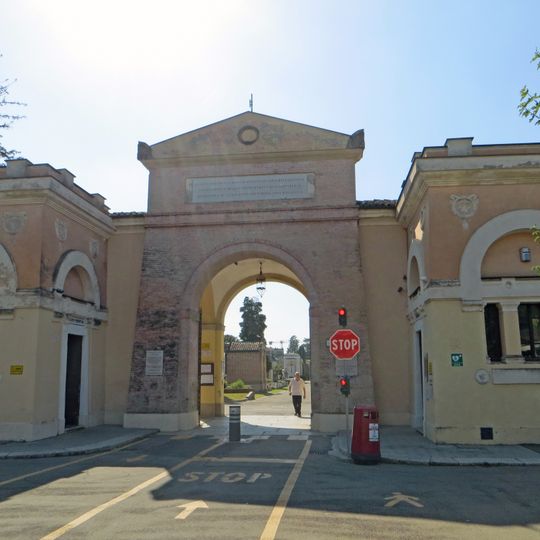
Villetta Cemetery, Neoclassical cemetery in Parma, Italy.
Villetta Cemetery is a walled burial ground in Parma whose plan is an octagon of 156 brick arcades with crypts beneath, each arcade bought and built by a religious order, institution or noble family. Inside, two crossing avenues divide the central field into four sectors for ordinary citizens. Two neoclassical Latin-cross galleries, south (1884) and north (1905), open onto the octagon's side sides.
Parma's council planned a cemetery from 1764, and after Napoleon's 1804 Saint-Cloud edict banned burials inside the walls, Duchess Marie Louise had architect Giuseppe Cocconcelli design one on the San Pellegrino estate, home of the Jesuit-built casino called "la Villetta". Work began in 1819; the first burial, poet Angelo Mazza, came before construction started. The octagonal portico's 156 arches were finished only in 1876.
The name comes from the Casino Rosso, a summer villa of the Collegio dei Nobili known as "la Villetta", built by the Jesuits in 1675. The first family edicola in the four sectors was Paganini's tomb, erected in 1889 to a neoclassical design by Marco Sante Bergamaschi; bourgeois families then commissioned liberty, déco and neo-medieval monuments from Parma's architects.
The cemetery is located within Parma and is accessible on foot from various points in the city; staff are available at the administration office for information. Wear comfortable shoes since the grounds are extensive and require walking through multiple sections.
The first family chapel in the octagon was built in 1889 for violinist Niccolò Paganini, designed in neoclassical style by engineer Marco Sante Bergamaschi. It set the pattern for the family tombs that followed, erected by bourgeois families and designed by Parma's best-known architects in Liberty, Deco, neo-medieval and eclectic styles.
The community of curious travelers
AroundUs brings together thousands of curated places, local tips, and hidden gems, enriched daily by 93,194 contributors worldwide.