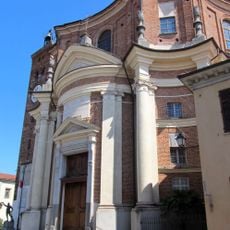
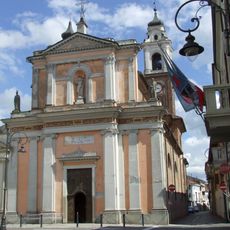
Santi Agata e Giorgio, Collegiate church in Santhià, Italy
Santi Agata e Giorgio is the collegiate church of Santhià, rebuilt in 1836 by architect Giuseppe Talucchi with a three-nave basilican plan. A large Neoclassical pronao, frescoed with religious scenes by Luigi Hartmann, fronts the facade, while the massive 12th-century brick Romanesque bell tower rises on the right side. Inside, two rows of large columns divide the naves beneath a vault painted with the Gloria di Sant'Agata by Paolo Emilio Morgari (1862).
A church existed on this site by the 10th century, and a canonical college was active in the 11th. The Romanesque building of the 12th century left only the brick bell tower and the crypt of Santo Stefano. After destruction in wars under Savoy rule, Giuseppe Talucchi rebuilt the church in 1836 with a three-nave Neoclassical plan.
The church serves as the main place of worship for Santhia's Roman Catholic community, hosting weddings, baptisms, and religious celebrations throughout the year. It remains central to the town's spiritual life and local traditions.
The church stands on Piazza Roma in central Santhià, a short walk from the town hall. The Romanesque bell tower and the crypt of Santo Stefano, reached beneath the presbytery, are the oldest parts to look for. It is an active parish church, so visits are best arranged around services.
The Romanesque crypt of Santo Stefano, under the presbytery, dates from the second quarter of the 12th century and has bare columns without decorated capitals and cross vaults with marked ribs. It served the liturgical functions of the college of canons. The 1861 Serassi organ, opus 654, has two 61-key manuals and a 17-pedal board.
The community of curious travelers
AroundUs brings together thousands of curated places, local tips, and hidden gems, enriched daily by 94,504 contributors worldwide.