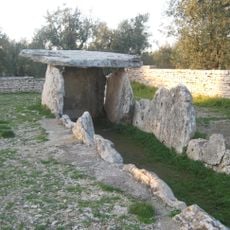
Dolmen di Albarosa, Bronze Age dolmen in Bisceglie, Italy.
The Albarosa dolmen is a prehistoric burial chamber with a limestone block corridor that extends several meters. Crossstones divide the interior into separate sections, with the entire structure reaching roughly two meters in height.
The megalith was discovered in 1909 by archaeologist Francesco Samarelli, at the same time as the nearby Dolmen della Chianca and Dolmen Frisari. Excavations by Gervasio found pottery fragments, a coarse-ware jug, hut plaster and stone tools from an earlier Neolithic settlement. Between 1961 and 1965 Francesco Biancofiore dated the mound to the end of the Middle Bronze Age and the start of the Late Bronze Age, the 14th to 13th century BC, and found the tomb had been robbed over time. Francesca Radina of the Puglia archaeological superintendency directed repairs to the gallery in 1987.
The name Albarosa comes from the farmstead and plateau of the same name near the Lama di Santa Croce, land of the Berarducci family. The tomb was found inside a large stone cairn called the specchione di Albarosa, originally about 19 m long, 16 m wide and 5 m high, later reduced by the removal of stones for nearby trulli. Excavations by Gervasio yielded pottery fragments, a coarse-ware jug, hut plaster and stone tools from an earlier Neolithic settlement.
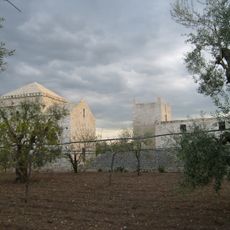
The site sits on an artificial earthen mound in rural terrain accessible by country paths. It is best visited during cooler hours of the day, as the area is open and offers little shade.
When found in 1909, the tomb lay inside a stone cairn called the specchione di Albarosa, then about 19 m long, 16 m wide and 5 m high; stone was later taken from it to build nearby trulli, so its elliptical plan is reduced today.
The community of curious travelers
AroundUs brings together thousands of curated places, local tips, and hidden gems, enriched daily by 94,364 contributors worldwide.