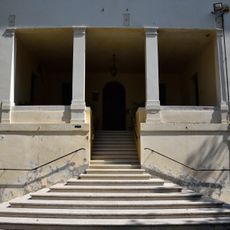
Cathedral of Saint Andrea, Neoclassical cathedral in Portogruaro, Italy
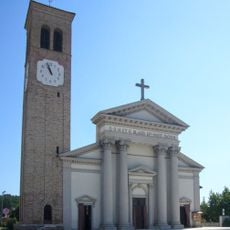
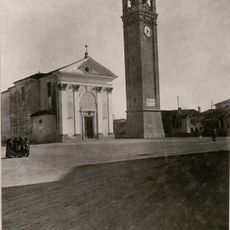
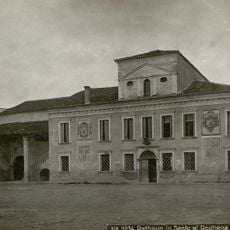
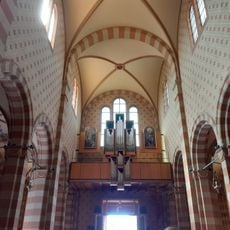
The Cathedral of Saint Andrea, known in Italian as the duomo di Portogruaro, is a neoclassical church designed by the architect Antonio De Marchi (1781–1867) of Stevenà di Caneva. It has three naves and measures 55.07 m in length, 20.38 m across the transept and 23.40 m up to the central dome. Construction began on 4 August 1793 and the building was consecrated on 4 August 1833 by bishop Carlo Fontanini.
The current building was commissioned in the late 18th century, when the town needed a larger place of worship to serve its growing population. It replaced an older church on the same site that had become too small for the community.
The church is dedicated to Saint Andrew the Apostle and was the pieve of Portogruaro, whose community held its jus patronatus until 31 October 1951. From 1586 it served as the auxiliary church of the bishops of Concordia, who resided in Portogruaro until 1974; it remains the bishops' burial church. In 1896 Cardinal Giuseppe Sarto, later Pope Pius X, presided here over the Veneto regional meeting of the Opera dei Congressi.
The cathedral is open on most days, but visiting hours can vary around religious services. Going in the morning tends to be quieter and gives you more time to look around the interior without interruption.
The church served as the bishops' burial church of the diocese even after the bishop's residence moved to Pordenone on 26 October 1974. The old parish church of Sant'Andrea had up to fifteen altars, reduced to nine by the apostolic visitor Cesare Nores, bishop of Poreč, in 1584.
The community of curious travelers
AroundUs brings together thousands of curated places, local tips, and hidden gems, enriched daily by 92,892 contributors worldwide.