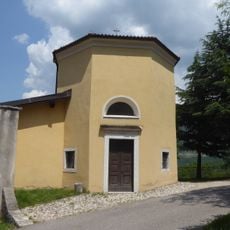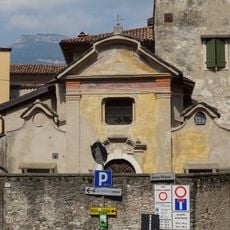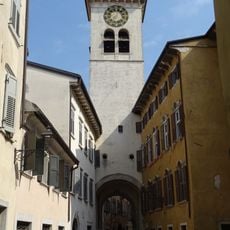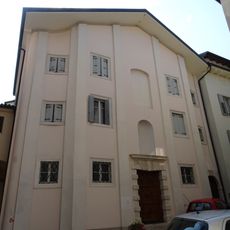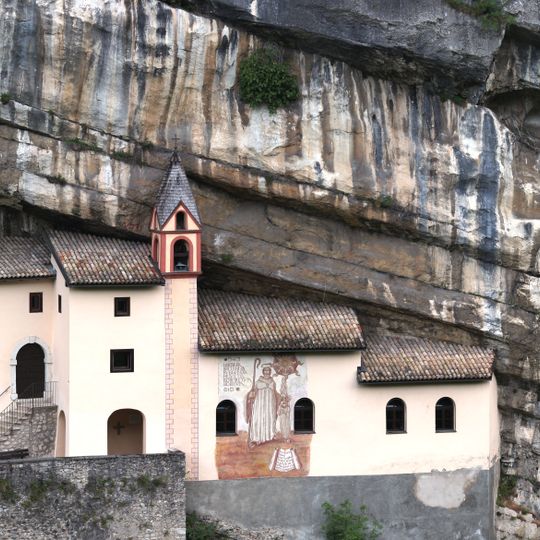
Saint Columbanus hermitage, Monastic hermitage on a cliff face in Trambileno, Italy.
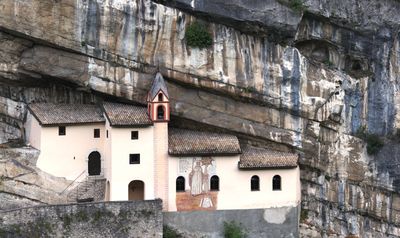
Saint Columbanus hermitage is a church built halfway up a steep rocky cliff and reached by 102 steps carved directly into the stone. The structure combines natural cave formations with walls and chambers constructed within the mountain itself.
A monk carved the date 753 into the rock beside the present bell tower, marking the start of continuous hermit life in the caves. A small church dedicated to the saint was built at the cave mouth between the late 10th and early 11th century. The first document naming it is a 1319 bequest by Count Guglielmo Castelbarco; the present church was completed in 1720. Hermit practice was abolished under Josephinism in 1782, and the province of Trento restored the site in 1996.
Frescoes inside depict a local legend about a saint battling a dragon near a mountain stream. These paintings show stories that have been told in this region for centuries.
Access is via 102 steps cut into the rock beside the bell tower, on the wall of the gorge of the Leno di Vallarsa stream in Trambileno, a short distance from Rovereto. The stairway is narrow and exposed, so it is not suited to visitors with vertigo or limited mobility. The Province of Trento restored the site in 1996 and opened it to the public; a volunteer group, the Committee Friends of St. Columban, maintains it.
The 753 date carved on the rock beside the bell tower marks the earliest trace of hermit monks here, centuries before the church. The cave frescoes show Saint Columbanus fighting a dragon, a legend linked to children baptised in the Leno stream below. The 15th-century Madonna and Saints altar fresco carries invocations and ex-votos dated 1505 to 1782.
The community of curious travelers
AroundUs brings together thousands of curated places, local tips, and hidden gems, enriched daily by 94,114 contributors worldwide.