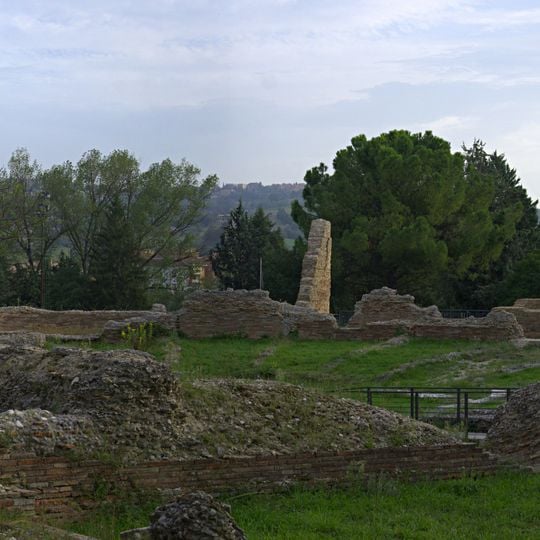
Ricina, Roman archaeological site in Villa Potenza, Macerata, Italy
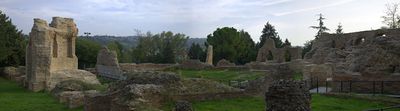
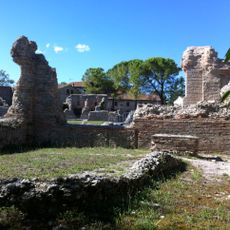
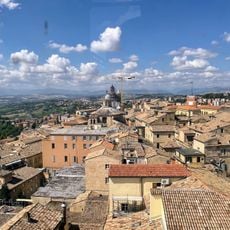
Ricina is a Roman town site in the lower Potenza valley at Villa Potenza, a hamlet of Macerata, partly covered by modern houses and farmland. Its layout was an almost rectangular area of about 22 hectares crossed by the valley road from Trea to Potentia as main decumanus. The theatre, the only well-preserved remain above ground, has a cavea 71.80 m in diameter; traces of an amphitheatre were detected east of it in 2009.
The settlement grew along an ancient Roman road and became a recognized center in the region over time. Emperor Septimius Severus elevated it to the status of a Roman colony in the early 3rd century, giving it the full name Helvia Ricina Pertinax.
The name changed over the centuries from Ricina to Recina and finally to Helvia Recina Pertinax, after the emperor Pertinax. A late epigram, unearthed by the humanist Niccolò Peranzoni in the early 16th century, links the name to a temple of Venus Ericina. The first bishop of Helvia Recina was Flaviano, martyred around the 3rd century.
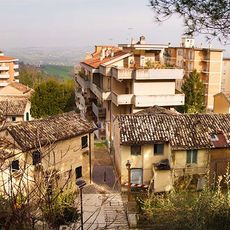
The site lies in Villa Potenza, a hamlet of Macerata, on the left bank of the Potenza river about 15 km from its estuary; much of the ancient town is now farmland and partly covered by the hamlet's houses. The theatre, the only well-preserved structure above ground, has a cavea 71.80 m in diameter and stands among modern houses. Crop-marks in the fields north of the centre reveal large buildings, so the visible remains are best read together with the layout of the surrounding plots.
The theatre is the only substantial structure still visible above ground, with a cavea 71.80 m in diameter, now hemmed in by the modern houses of Villa Potenza. Aerial photographs taken in May 2009 revealed traces of an amphitheatre just east of it, possibly once part of the same complex.
The community of curious travelers
AroundUs brings together thousands of curated places, local tips, and hidden gems, enriched daily by 93,036 contributors worldwide.