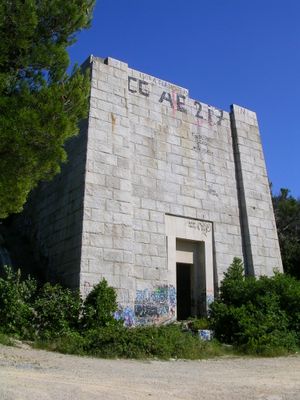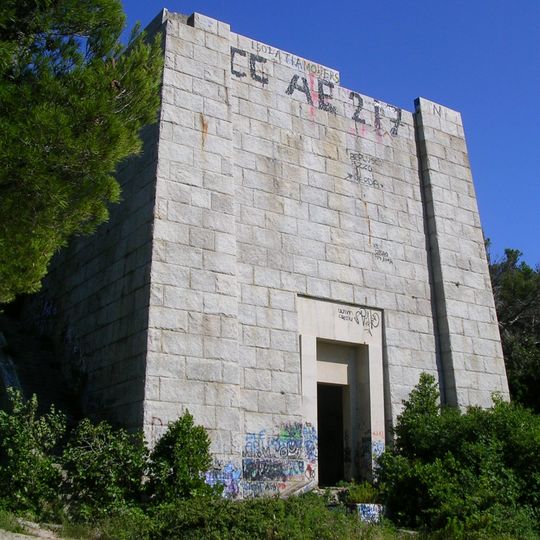
Mausoleum of Ciano, Mausoleum in Montenero district, Livorno, Italy.
The Mausoleum of Ciano is an early 20th-century tomb located on a hill in the Montenero district of Livorno. The structure features stone archways and columns with marble elements that once framed views toward the Mediterranean and the city below.
Construction began in 1939, after the death of the Fascist leader Costanzo Ciano, funded by a public subscription of 100,000 lire opened by Livorno's podestà. Sculptor Arturo Dazzi handled the statuary and called in architect Gaetano Rapisardi; the project, with a 12-metre statue and a fasces-shaped lighthouse over 50 metres tall, was submitted in 1940. Work stopped with the fall of Fascism, and German sappers blew up the lighthouse.
The name recalls Costanzo Ciano, a Fascist leader who died in 1939; the mausoleum was funded by a public subscription opened by Livorno's podestà, raising 100,000 lire of the time. Sculptor Arturo Dazzi handled the statuary and brought in architect Gaetano Rapisardi. The planned 12-metre statue of Ciano at the helm of his MAS was never installed; its unfinished head and body parts remain at the quarry on Santo Stefano island, La Maddalena.
Access to the mausoleum involves walking up an unpaved path with no marked trails or signs, making navigation difficult. Wear sturdy shoes and be aware that the site has no safety railings or protective barriers.
The unfinished 12-metre statue of Costanzo Ciano at the wheel of his MAS lies abandoned on the island of Santo Stefano, La Maddalena, near the quarry where it was being carved when work stopped; only the head and parts of the body remain. Three smaller statues meant to decorate the monument stand at Forte dei Marmi: two sailors on the seafront and a balilla in a small park at the corner of via Piave and via Mascagni.
The community of curious travelers
AroundUs brings together thousands of curated places, local tips, and hidden gems, enriched daily by 93,360 contributors worldwide.