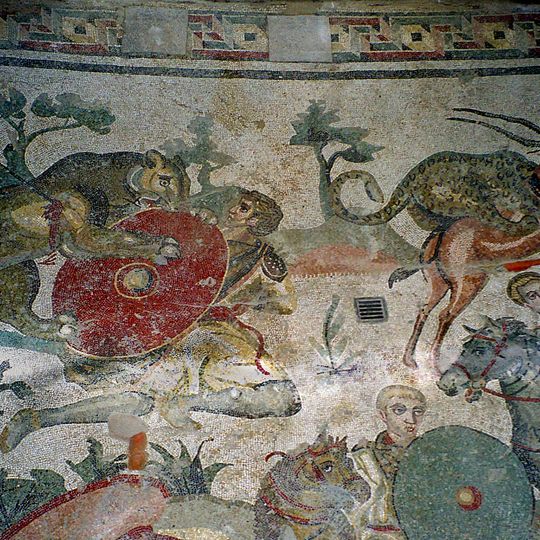
Big Game Hunt mosaic, Roman mosaic in Villa Romana del Casale, Sicily, Italy.
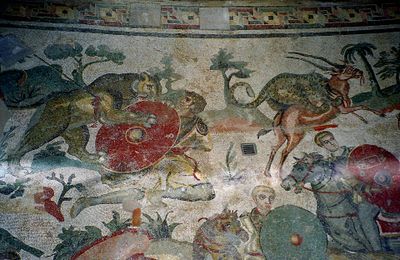
The Big Game Hunt mosaic covers the floor of a 66-metre-long, 5-metre-wide raised corridor in the Villa Romana del Casale. Its central field shows a spotted feline leaping right above a fallen figure with a round red shield, while a dark-maned animal grips another figure and a mounted rider on a pale horse faces a dark-maned horse's head. A rectangular grate interrupts the scene between the fighters.
The mosaic is dated by stratigraphic analysis to 320–330 AD. Two workshops laid it: the northern half uses 5–6 mm tesserae with faience and about 25 colours, the southern half coarser 6–8 mm stone tesserae and 15 colours. The southern figures follow third-century western models; the northern ones draw on Hellenistic models absorbed in Greece or Anatolia.
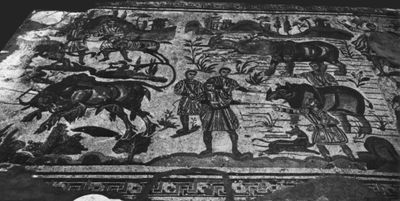
The two female figures in the end apses personify the source regions: the worn northern one, with a lion and leopard, is read as Mauretania or Africa, while the olive-skinned southern figure with a small-eared elephant, a tiger and a phoenix stands for Egypt, Asia or India. Red cords hanging from branches, the formidines used by Indian hunters, mark the capture scenes.
Access is via elevated walkways that protect the original floor and let you view the details up close. The site lies outside Piazza Armerina and is open most days; wear comfortable shoes since there is a lot of walking involved.
The corridor's two halves were laid by different workshops: the north uses 5–6 mm tesserae with about 25 colours and glass faience, the south coarser 6–8 mm stones in roughly 15 colours. Look for the seam where the styles change. The scenes were meant to be read while walking, like Trajan's Column.
The community of curious travelers
AroundUs brings together thousands of curated places, local tips, and hidden gems, enriched daily by 92,784 contributors worldwide.