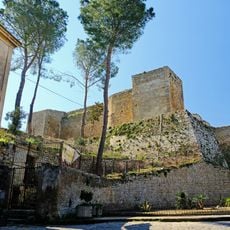
Priorato di Sant' Andrea, Medieval church in Piazza Armerina, Italy.
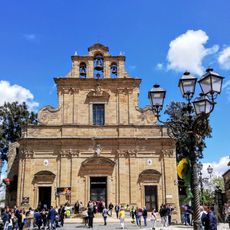
The Priorato di Sant'Andrea is a Romanesque church built with stone walls, arched windows, and a rectangular layout near the town center of Piazza Armerina. The structure features a main entrance on the western side and an interior containing medieval frescoes on its walls.
Founded in 1096, the church was granted in 1106 to the Knights of the Holy Sepulchre by Count Simone del Vasto, nephew of Count Roger I. In 1148 Aleramico and his wife Thomasia donated it with its cenobium and a substantial income used for the defence of Jerusalem until 1244. The temple was probably rebuilt after the 1169 earthquake, and in 1392 the complex became a Grand Priory with ducal dignity and the thirty-fifth seat among the peers of the kingdom.
The church displays medieval frescoes showing religious scenes that reflect how early Christian communities in Sicily expressed their faith visually. These artworks on the walls remain visible to visitors today, offering a window into local spiritual life.
Visitors can enter the church through the main entrance on the western facade and walk through the stone interior with its arched architectural features. Taking time to examine the wall frescoes indoors is worthwhile, and the location near the town center makes it easy to visit.
The church is the only surviving remnant of the priory founded in 1096; the adjoining cenobium has disappeared. Its plan is described as an Egyptian cross or Saint Anthony's cross, with a massive outline and arrow-slit openings. The portals date from the 13th century, and frescoes span the 12th to 15th centuries.
The community of curious travelers
AroundUs brings together thousands of curated places, local tips, and hidden gems, enriched daily by 94,126 contributors worldwide.