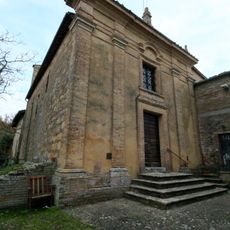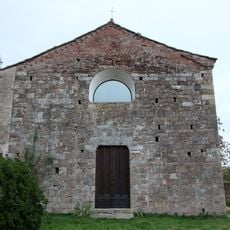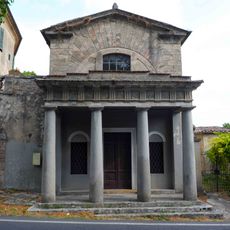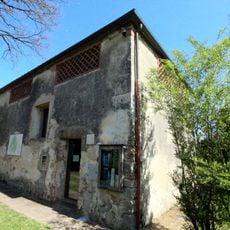
Santa Mustiola, Romanesque monastery in Sovicille, Italy
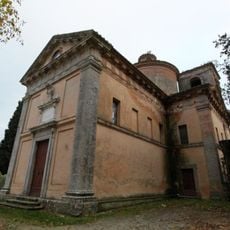
Santa Mustiola is a Romanesque monastery featuring a three-tiered cloister with eleven arches on each side, supported by slender columns adorned with carved plant designs. Inside, visitors find a stone altar in Romanesque style and a painting by Luca di Tommè showing the Madonna with Child.
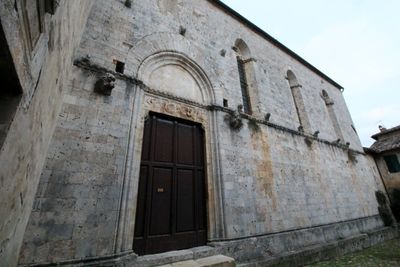
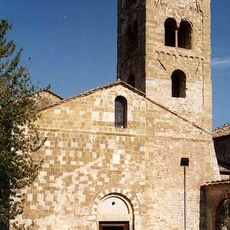
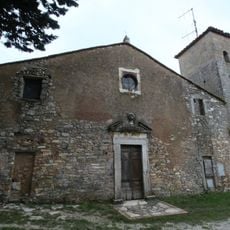
The monastery is first documented in 1070 as an abbey of the Vallombrosan Congregation. The church was renovated in the 13th century, keeping its single nave with a wooden roof, while Gothic features were added on the south side. Two upper storeys were built over the cloister in the 14th and 15th centuries.
The name Santa Mustiola refers to a martyr of Chiusi; the monastery is also called della Santissima Trinità. Inside the church, look for the Romanesque stone high altar and a panel by Luca di Tommè showing the Madonna and Child. The cloister capitals carry carved plant motifs, with pulvini above them decorated with geometric patterns and interlaced ribbons.
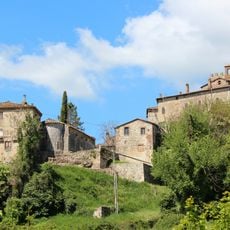
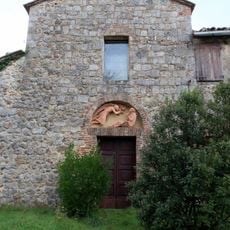
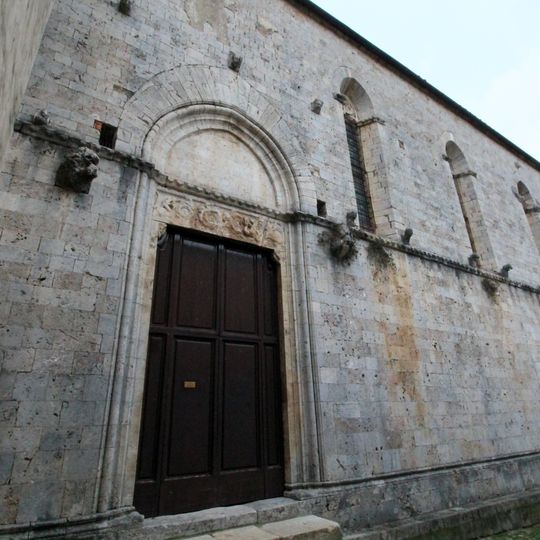
The monastery stands in Torri, a hamlet of Sovicille about 10 km southwest of Siena, reached by local roads through the Montagnola Senese. The cloister and church are visited on foot, so allow time to compare the eleven arches of each side and the carved capitals at close range. The southern portal with its pointed arch and sculpted architrave faces the open side and is best examined in daylight.
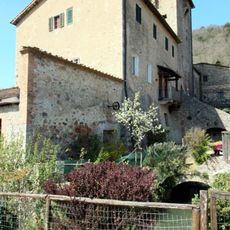
The cloister kept its Romanesque form through the two upper storeys added in the 14th and 15th centuries: eleven arches per side on slender columns, with capitals carved with plant motifs and pulvini bearing geometric patterns and interlaced ribbons. The trichromy of white, pink and black stone is achieved with local stone materials.
The community of curious travelers
AroundUs brings together thousands of curated places, local tips, and hidden gems, enriched daily by 94,019 contributors worldwide.