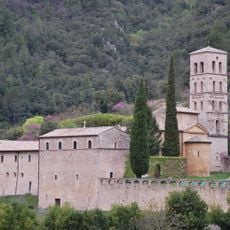
Museo delle mummie, Mummy museum in Ferentillo, Italy
The Museum of Mummies occupies the 13th-century crypt of Santo Stefano Church in Ferentillo, a 24-metre-long, 9-metre-wide hall about 2 metres high. It displays 24 human mummies, 10 preserved heads and over 270 skulls, plus a sealed coffin and two mummified birds.
The crypt of Santo Stefano, built over a 13th-century church, served as the village burial place from the 16th century until the last interment on 18 May 1871. After the Napoleonic Edict of Saint-Cloud extended to Italy in 1806, the Capuchin friars had the bodies disinterred in 1871 and found many almost perfectly preserved. In 1887 the Accademia dei Lincei published a study by Carlo Maggiorani and Aliprando Moriggia attributing mummification to the soil and ventilation.
The collection displays remains of local inhabitants from different social backgrounds, revealing how communities honored their dead in previous centuries. These preserved individuals tell stories about the social structure and beliefs of people who lived in Umbria.
The museum is in the crypt of Santo Stefano Church in the Precetto part of Ferentillo, at the foot of Monte S. Angelo along the road to the pentagonal rocca. The crypt is about 24 metres long, 9 wide and 2 high, so the space is narrow and the route passes close to the display cases.
The mummification occurred naturally due to the unique soil chemistry and conditions in the crypt, a process studied and documented by the Accademia dei Lincei in 1887. This early scientific investigation became one of the first detailed analyses of how natural preservation works.
The community of curious travelers
AroundUs brings together thousands of curated places, local tips, and hidden gems, enriched daily by 93,519 contributors worldwide.