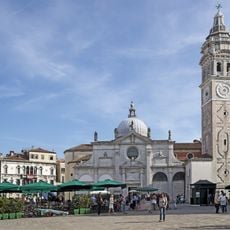
Palazzo Querini Stampalia, Renaissance palace in Castello district, Venice, Italy
Palazzo Querini Stampalia is a 16th-century palace featuring traditional Venetian design with ornamental exterior details and rows of windows facing the canals. Today it houses a museum with artworks, a public library, and an interior garden open to visitors.
Two small houses stood on the site in 1514; the palace was built in the following decade, and on 3 January 1525 Marin Sanudo records a lavish wedding banquet here for a Querini bride and Francesco Mocenigo. Around 1700 a bridge linked it to Santa Maria Formosa. In 1789-1797, for Alvise Querini's marriage to Maria Teresa Lippomano, a floor was added and Jacopo and Vincenzo Guarana frescoed the nuptial chamber within Giuseppe Castelli's stuccoes. Count Giovanni Querini Stampalia left everything to Venice on his death in 1869, and the foundation he created in 1868 opened the library and art collections.
The palace's name joins two branches of the same family, Querini and Stampalia. Count Giovanni Querini Stampalia, its last heir, left the building, furnishings, paintings and library to Venice on his death in 1869; the foundation he set up in 1868 opened the library on the first floor to the public.
The ground floor was unusable because of frequent acqua alta, so Carlo Scarpa's restoration, begun ten years after the 1949 commission, raised the walkways and let water enter and drain through the entrance. The garden he replanted with a small fountain lies behind the palace, reached by the new access bridge he built.
Architect Carlo Scarpa created an innovative solution in the mid-20th century to handle flooding conditions. The ground floor is intentionally allowed to flood while upper areas remain protected through a special structural design.
The community of curious travelers
AroundUs brings together thousands of curated places, local tips, and hidden gems, enriched daily by 93,008 contributors worldwide.