Palazzo Rinuccini, Florence, Renaissance palazzo in Via Santo Spirito, Florence, Italy
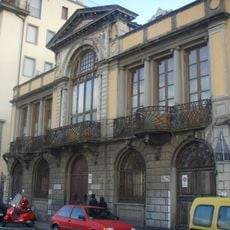
Palazzo Rinuccini occupies numbers 31 to 41 on Via Santo Spirito, where three formerly separate buildings were joined behind a single facade in the first half of the 18th century. The left block runs three storeys over eight bays on Via dei Serragli, with twin portals topped by shallow balconies and windows framed in stone. A shield with the Rinuccini arms (a band of lozenges with a three-pendant label) marks the carriage entrance at Via Maffia 8 rosso.
The palazzo grew from several older houses on Via Santo Spirito, some once belonging to the Soderini and confiscated in the 16th century for their role in anti-Medici plots. Around 1605 Virginia Savelli, widow Vitelli, bought and merged two houses, and a facade built between 1606 and 1610 is traditionally attributed to Lodovico Cardi, called il Cigoli. From 1753 Giulio Mannaioni joined the corner houses on Via Maffia, finishing those facades in 1758. In 1848 the property was divided among the daughters of Pier Francesco Rinuccini, the last male heir; in 1919 it passed to the City of Florence as a school.
The building displays artworks from different periods created by regional and broader Italian masters within its rooms. This collection reflects the taste and connections of the family who lived here over generations.
The complex runs along Via Santo Spirito from numbers 31 to 41, at the corner with Via Maffia and Via dei Serragli, in the Oltrarno district. Since 2003 it has housed the Liceo Niccolò Machiavelli, so the entrance and courtyards are school premises; visitors should look at the facade from the street rather than expect interior access.
The palace once held one of Florence's most notable private art collections; Federico Fantozzi's 1842 guide devotes sixteen pages to it. Frescoes by Bernardino Poccetti, Giuseppe Zocchi (Four Seasons), Giuliano Trabellesi, Luigi Catani, Angiolo Sarri and Niccolò Connestabile (Myth of Niobe) remain, along with Girolamo Ticciati's statue of Architecture, carved in 1736 for the staircase.
The community of curious travelers
AroundUs brings together thousands of curated places, local tips, and hidden gems, enriched daily by 93,743 contributors worldwide.