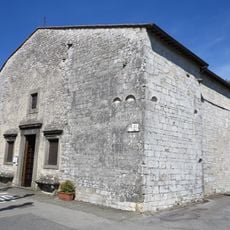
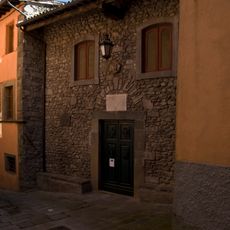
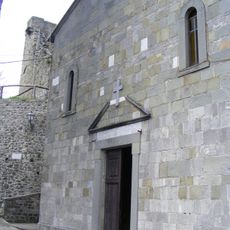
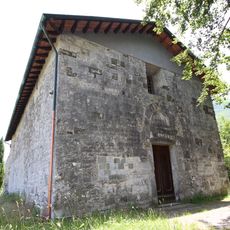
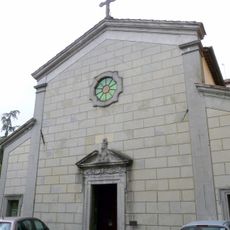
Santa Maria, Romanesque church in Loppia di Sopra, Italy
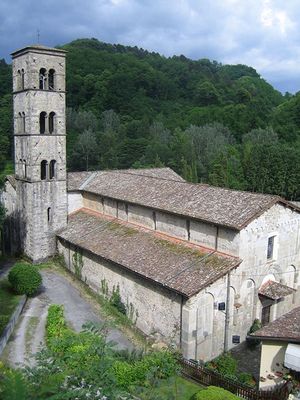
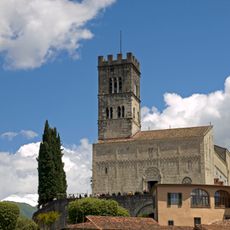
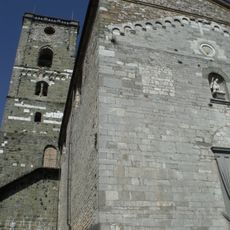
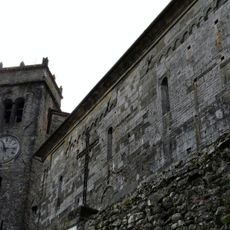
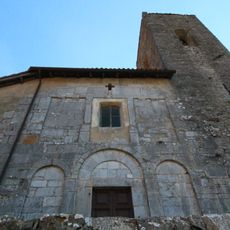
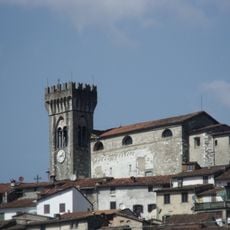
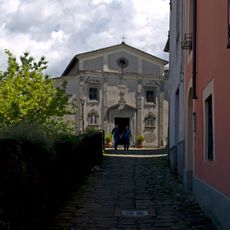
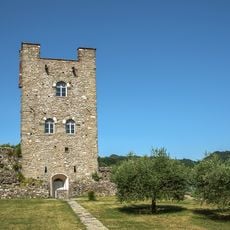
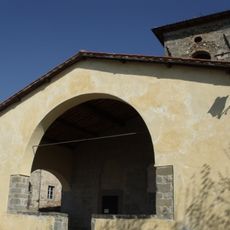
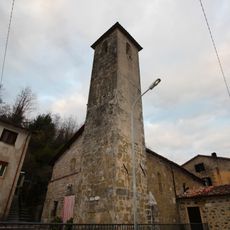
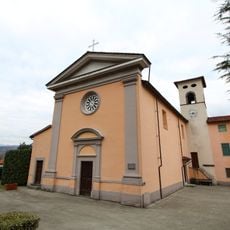
Santa Maria, the pieve di Santa Maria Assunta in Loppia, is a Romanesque church with three naves, a projecting transept and a single semicircular apse partly rebuilt in the 12th century. Blind arcades run along the lower facade and the apse head, and a 15th-century bell tower with three tiers of biforas stands on the left side.
The church is documented as early as 764 and again in 845, when it came under the Rolandinghi, who had their castle seat beside it. Countess Beatrice di Canossa had it rebuilt in Romanesque form and its present dimensions by 1058, the year Bishop Anselmo I da Baggio consecrated it; work may have begun under his predecessor Giovanni Da Besate. After a period of abandonment it was restored in the 16th century.
The church is named for Santa Maria Assunta, the Assumption of Mary, and was documented as a pieve, a baptismal church with jurisdiction over surrounding communities, from 764. Inside, the left nave holds two paintings by Baccio Ciarpi brought from Barga's Duomo di San Cristoforo: a Decollazione del Battista dated 1626 and a Cristo crocifisso e santi.
The pieve stands in Loppia, a hamlet of Barga, reached by local roads climbing from the town; the church sits on the left bank of the Loppia stream. The fifteenth-century bell tower rises on the left side of the building, a useful landmark when approaching. The interior is entered from the facade and walked through three naves divided by pillars, with the organ on the floor of the left transept.
The organ in the left transept was built by Domenico Pucci between 1843 and 1845 and restored by the Fratelli Marin in the second half of the 20th century. It has mechanical transmission, 18 registers on a single manual and pedal, and stands at floor level against the rear wall.
The community of curious travelers
AroundUs brings together thousands of curated places, local tips, and hidden gems, enriched daily by 93,028 contributors worldwide.