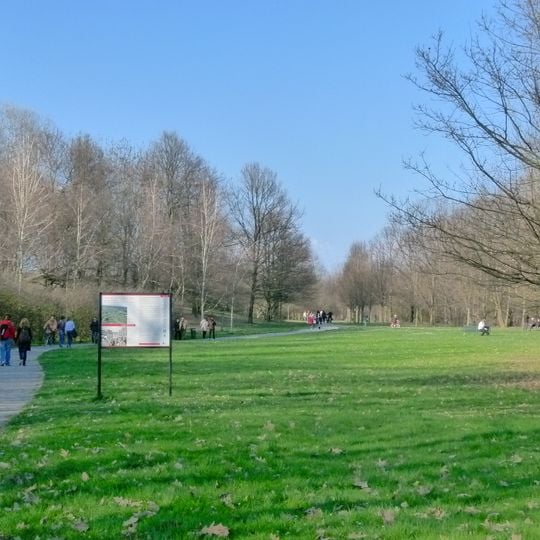
Bosco delle Querce, Regional park in Meda and Seveso, Italy.
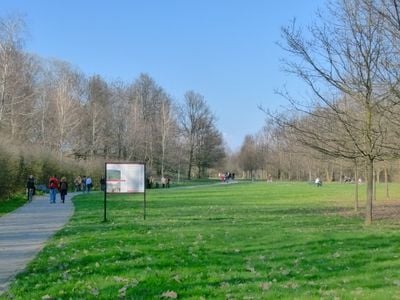
Bosco delle Querce is a regional park covering 43 hectares across Meda and Seveso at 210 meters above sea level. The area divides into five sections with mixed woodland of oaks, pines, birches, hornbeams, and willows, alongside recreational and protected zones.
On 10 July 1976 a reactor failure at the ICMESA chemical plant in Meda released a cloud of TCDD, which spread over Seveso, Meda, Cesano Maderno and Desio. Zone A, about 15 hectares at first and later 108, was evacuated and fenced off; the polluted topsoil was dug out to an average depth of 46 cm and sealed in two concrete basins, 200,000 m³ at Seveso and 80,000 m³ at Meda, built between 1981 and 1984. In 1983 Seveso decided to make a park over the basins; planting ran from 1984 to 1986, when the park passed to the regional forest agency, with the replanting designed by agronomist Paolo Lassini.
The park's name, Bosco delle Querce, refers to the oaks planted over the sealed containment basins. The reforestation was designed by agronomist Paolo Lassini, and pedunculate oak, field maple and hornbeam dominate the woodland today. The two concrete basins beneath the trees hold the excavated topsoil of zone A, removed to an average depth of 46 centimetres.
The park lies in the former zone A, split between Seveso and Meda; the Seveso containment tank holds 200,000 m³ and the Meda one 80,000 m³, buried under the planted ground. Paths cross open grass and young woodland, so walking shoes are useful. The information panels, like the white one on two dark posts, give the site's history.
The woodland was artificially created but designed to look and function like a natural forest, which many visitors do not realize. This reconstruction demonstrates how damaged land can be returned to support a living ecosystem.
The community of curious travelers
AroundUs brings together thousands of curated places, local tips, and hidden gems, enriched daily by 93,017 contributors worldwide.