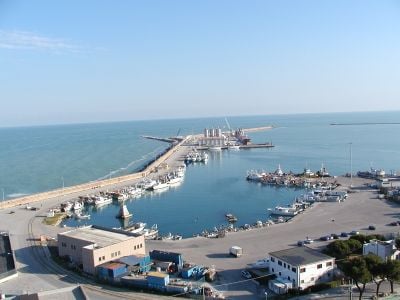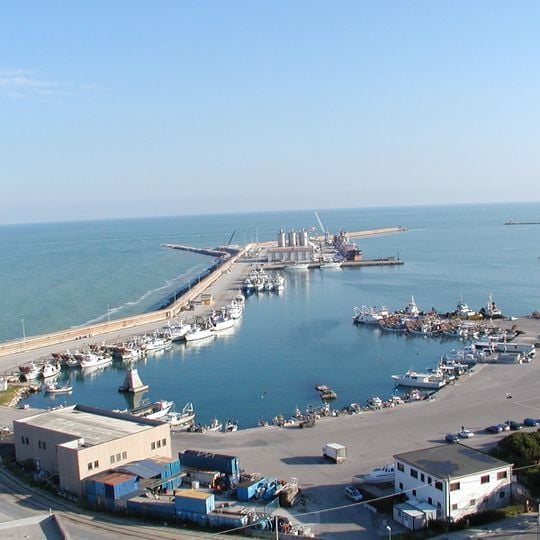
Port of Ortona, Maritime facility in Ortona, Italy
The Port of Ortona is a commercial facility on the eastern Abruzzo coast that handles steel, salt, vehicles, and petroleum across multiple specialized terminals. The infrastructure spreads along the waterfront, connecting loading docks with storage facilities designed for different cargo types.
The port was attacked by the Venetians in 1447 and then extensively rebuilt by Alfonso of Aragon around 1452, together with the Aragonese castle. In 1258 the relics of Saint Thomas the Apostle were landed here by Captain Leone Acciaiuoli, and in 1326 Saint Bridget of Sweden disembarked to venerate them. On 21 July 1566 Ottoman forces landed in the small bay still called "Saraceni" and sacked the town.
The port's name appears in the medieval double gateway system: Porta della Marina and Porta Castello both opened onto the harbour. In 1258 the relics of Saint Thomas the Apostle arrived here, carried ashore by Captain Leone Acciaiuoli, and in 1326 Saint Bridget of Sweden landed at the port to venerate them. The small gulf where the Ottomans came ashore on 21 July 1566 is still called "Saraceni" in memory of the raid.
The port has five piers: Molo nord (457 m, 6.8 m depth), Molo martello (130 m, 5.7 m), Molo di riva (236 m, 5.7 m), Molo di riva nuova (260 m, 5.7 m) and Molo commerciale (200 m, 5.7 m). A rail link connects it to Ortona station for freight. Seasonal pontoons serve pleasure craft.
A plaque at the base of the north pier recalls 9 September 1943, when Vittorio Emanuele III left from here for Brindisi with the court and Badoglio. In October–November the retreating Germans mined and blew up the harbour to prevent landings.
The community of curious travelers
AroundUs brings together thousands of curated places, local tips, and hidden gems, enriched daily by 94,680 contributors worldwide.