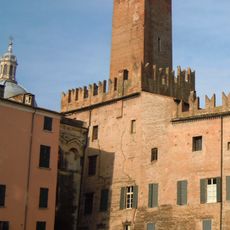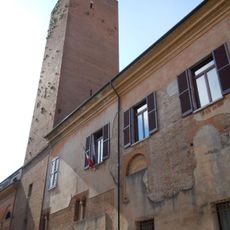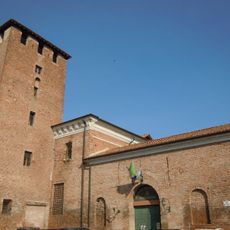
Bridge of san giorgio, Medieval stone bridge in central Mantua, Italy.
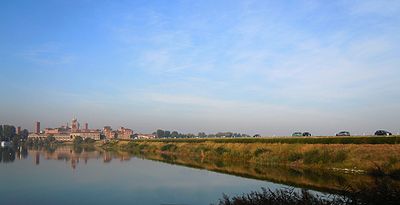
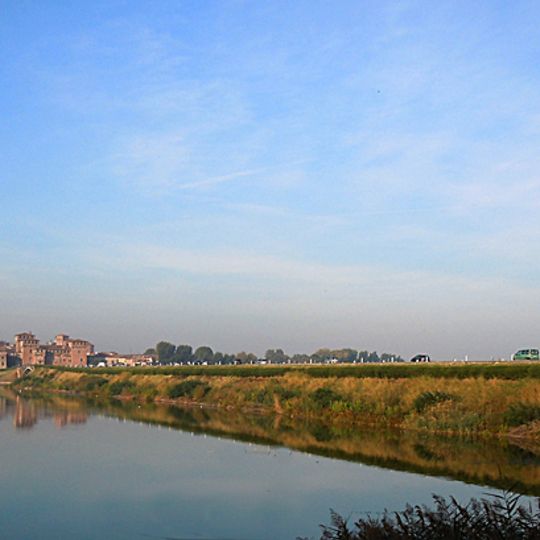
The Ponte di San Giorgio is a masonry bridge over the Lago di Mezzo in Mantua, dividing that lake from the Lago Inferiore. It replaced a wooden structure built in 1198–1199 under the engineer Alberto Pitentino and was rebuilt in stone at the end of the 14th century by Ludovico Gonzaga. Its arches were buried in 1922 and the drawbridge removed, giving the present crossing.
The bridge was first built in wood in 1198–1199 as part of engineer Alberto Pitentino's hydraulic works that created Mantua's lakes. At the end of the 14th century Ludovico Gonzaga rebuilt it in masonry, dividing the Lago di Mezzo from the Lago Inferiore. A roof added later was demolished on 25 September 1634 after damage during the 1630 siege by Landsknechts. In 1922 the arches were buried and the drawbridge replaced by the present structure.
The bridge appears in the background of Andrea Mantegna's Death of the Virgin (1460–1461), now in the Prado, and in Rubens's Self-Portrait with Friends in Mantua (1602–1606), kept in Cologne. A 1417 plaque in the Ducal Palace museum records that the bridge was covered.
The bridge carries the road across the Lago di Mezzo between the city centre and the San Giorgio district. Its arches were buried in 1922 and the drawbridge that once let boats pass between the middle and lower lakes was removed, so the crossing is now a fixed roadway; walkers share it with traffic.
The bridge appears in the background of Andrea Mantegna's Death of the Virgin (1460–1461), now in the Prado in Madrid, and also in Rubens's Self-Portrait with Friends in Mantua (1602–1606), kept in Cologne. The 1922 works buried its arches and removed the drawbridge that had let boats pass between the lakes of Mezzo and Inferiore.
The community of curious travelers
AroundUs brings together thousands of curated places, local tips, and hidden gems, enriched daily by 94,116 contributors worldwide.