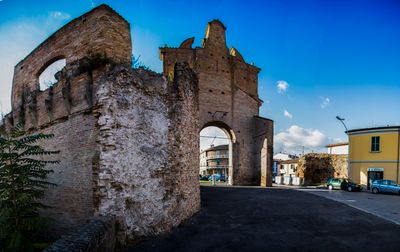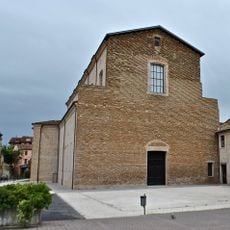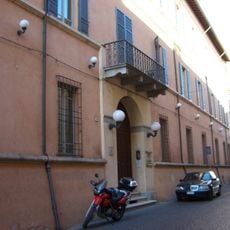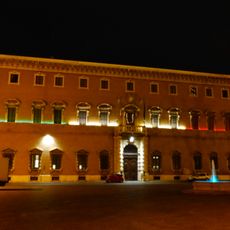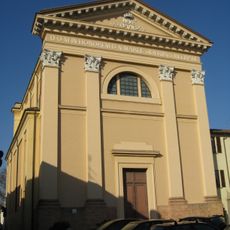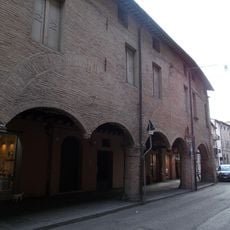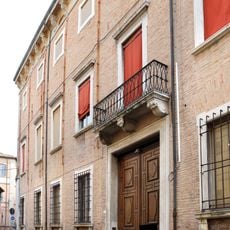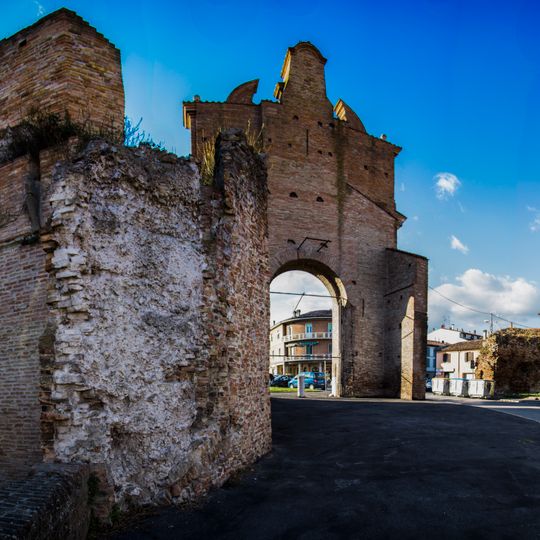
Porta Schiavonia, Baroque city gate in Forlì, Italy.
Porta Schiavonia is the only surviving gate of Forlì's city walls, standing at the western entrance on the Via Emilia facing the Montone river. It is built in baroque style with a monumental round arch. The 18th-century structure consisted of a central passage and a facade with a niche holding a painting of the Madonna del Fuoco between Saints Mercuriale and Valeriano; the passage was demolished in 1933, leaving only the main facade.
Porta Schiavonia is documented as early as 1282, when a suburb outside it is mentioned. After Porta Liviense was closed in 1356, the consular road was diverted here. Cardinal Cossa had a small fortress built in 1407, demolished in 1413; the gate was rebuilt between 1438 and 1499, demolished in 1556 by order of Pope Paul IV, and again in 1623 under Cardinal Domenico Rivarola. The present structure dates from 1743.
The gate once displayed religious imagery important to the city, such as a painting of Madonna del Fuoco with Saints Valeriano and Mercuriales on its outer wall. This shows how sacred themes were integrated into the design of public architecture during the baroque period.
The gate sits at the northern edge of the historic center near the Montone River along the ancient Via Emilia road. Visitors can easily reach it on foot as the main entry point from outside the city center.
This gate is the only surviving structure from Forlì's original city walls, making it a rare remnant of the city's medieval defenses. Nearby remain visible pieces of the Rocchetta fortification, which once worked alongside this gate for protection.
The community of curious travelers
AroundUs brings together thousands of curated places, local tips, and hidden gems, enriched daily by 93,038 contributors worldwide.