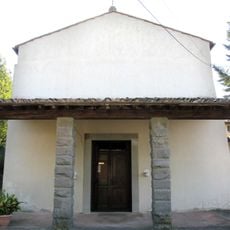
Pieve di Sant'Andrea, Romanesque church in Cercina, Italy
The Pieve di Sant'Andrea in Cercina, Sesto Fiorentino, is a rural church begun in the Romanesque style and later remade. Its sturdy bell tower has single and double mullioned windows, and the bell chamber projects beyond the tower shaft. A 16th-century portico links the church to the 16th-century facade of the canonica.
The pieve is documented in 880 as Santa Gerusalemme, later called Sant'Andrea by the mid-11th century. The Catellini da Castiglione held patronage and in the 14th century enlarged the rector's and pievano's quarters; in the 15th century they arranged the cloister. A wooden Virgin, perhaps 12th-century, drew an annual Florentine procession attended by St. Antoninus, Pope Leo X and the Medici.
A wooden sculpture of the Virgin, perhaps from the 12th century, drew veneration from a lay company of Florence that came in annual procession; among participants were St. Antoninus, Pope Leo X and members of the Medici family.
The pieve stands in Cercina, a hamlet of Sesto Fiorentino on the slope of Monte Morello, reached by a road climbing from the plain. The church is a rural pieve with a portico linking it to the 16th-century canonica facade; the entrance is through this portico. The Ghirlandaio frescoes in the right apse were walled up in the 17th century and uncovered in 1923, so they are seen in the apse to the right of the main altar.
The bell chamber overhangs the shaft of the campanile, an arrangement the sources single out as particularly original. The tower itself has single and double mullioned windows. Look up at the top of the tower to see how the bell cell projects beyond the masonry below it.
The community of curious travelers
AroundUs brings together thousands of curated places, local tips, and hidden gems, enriched daily by 94,447 contributors worldwide.