Fumane Cave, Prehistoric archaeological site and solutional cave in Fumane Valley, Italy.
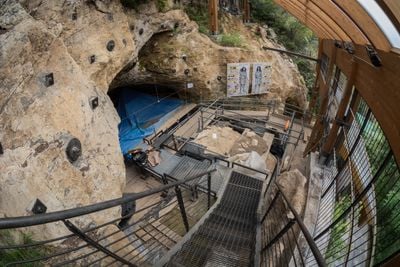
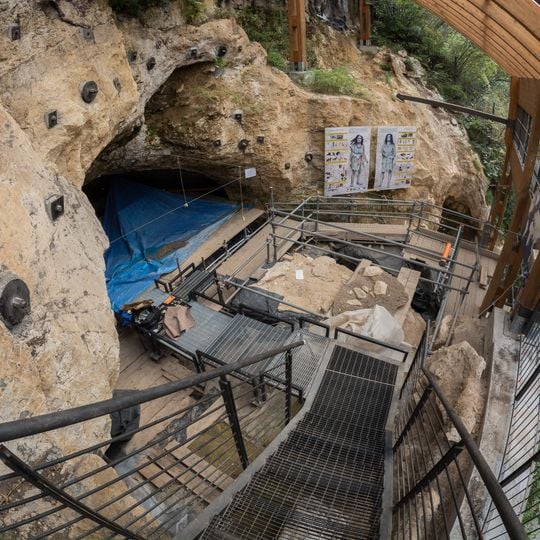
Fumane Cave, also called Riparo Solinas, is a dolomite cave in the Fumane Valley above the old road from Fumane to Molina. Its wide arched rock opening is fitted with metal walkways, railings and mesh grating forming stepped platforms, with a bright blue tarp over a sloped area and illustrated posters beside the entrance. Inside, the museum presents the stratigraphic excavation layer by layer, each with the finds recovered from it.
The cave was inhabited starting roughly 50,000 years ago and shows evidence of occupation by Neanderthals and early modern humans across multiple periods. Systematic excavations beginning in 1988 have revealed eleven distinct layers documenting this long span of time.
The cave displays red ochre paintings on stone slabs showing animals and human figures from the earliest periods of European art. These works reveal how ancient people expressed themselves through visual imagery.
The site is a museum structure built over the excavation, reached on foot along a steep road hundreds of metres from the nearest car park, so access is not convenient for visitors with reduced mobility. It has two entrances: the main one on the road, built in laminated wood and transparent plastic to let in daylight, and a secondary one inside the wood that reaches the upper part of the shelter without the ladder route. The stratigraphic excavation, dated by radiocarbon, is displayed and explained layer by layer.
Neanderthal teeth were discovered in the cave, providing direct evidence that these individuals spent time there. The stone tools found use different advanced production methods, reflecting the skill and adaptability of early inhabitants.
The community of curious travelers
AroundUs brings together thousands of curated places, local tips, and hidden gems, enriched daily by 92,807 contributors worldwide.