Temple of Clitumnus, Early Christian temple in Campello sul Clitunno, Italy.
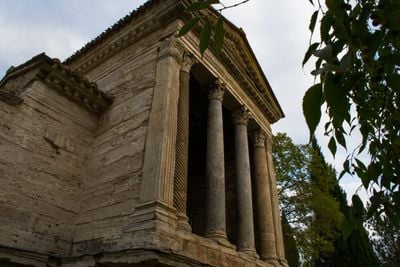
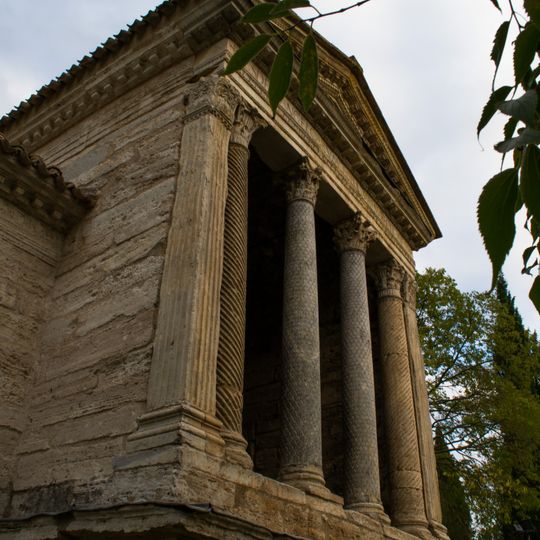
The Temple of Clitumnus, also called the Tempietto del Clitunno, is a small church of about 11 m in length at Pissignano, near Campello sul Clitunno in Umbria. Its upper part is a Corinthian temple front: four fluted columns between pilasters, the two outer shafts carved with spiral patterns, carrying a plain pediment with a cross at its centre. A barrel-vaulted lower chamber opens through a portal at the front.
The church was built in two phases: a barrel-vaulted room cut into the hillside, then an apse and three columned entry porticoes in Roman Corinthian style. Its 7th-century frescoes of Christ, Peter, Paul and angels link it to Byzantine icon models and to the Lombard duchy of Spoleto. In the 1730s the north and south portico fronts were dismantled and their columns sold.
The name Tempietto del Clitumnus links the church to the river god once honoured at the nearby springs, though it is dedicated to San Salvatore. On the architrave, west, south and north sides carry early medieval Latin inscriptions in square capitals, a rare survival of monumental lettering from that era.
The temple sits beside the river and is easy to reach on foot, especially when arriving through the nearby village. It is best visited during warmer months, as the humid climate around the waterway can affect the experience.
The two spiral-fluted columns flanking the facade are matched by plain pilasters, and the carved capitals are original early medieval work rather than reused Roman pieces. Renaissance architects took the building for a Roman temple: Palladio believed it was ancient, and Piranesi and Vanvitelli recorded it.
The community of curious travelers
AroundUs brings together thousands of curated places, local tips, and hidden gems, enriched daily by 93,519 contributors worldwide.