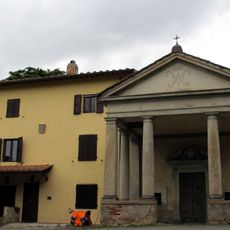
Tempio a Minerva Medica, Neoclassical temple in Montefoscoli, Italy.
The Tempio di Minerva Medica is a Neoclassical building on a hilltop in Montefoscoli, in the province of Pisa. Its front, modelled on the Pantheon in Rome, has an eight-column Ionic portico with an architrave and a pediment pierced by an oculus; the acroterion is a knot of serpents and the walls are red brick laid in opus reticulatum. Three entrances, three windows and three levels repeat a numerical scheme, and inside a helical staircase leads up towards the roof.
The temple was built between 1821 and 1823 when Professor Andrea Vacca Berlinghieri commissioned architect Ridolfo Castinelli to create it as a memorial to his father Francesco. This project emerged from personal family devotion and became part of the local architectural heritage during that period.
The temple's name and the epigraph over the main portal tie it to Minerva, goddess of medicine, honouring Francesco Vaccà Berlinghieri, a Pisan surgeon. Inside, the mosaic floor shows seven acacia branches ending in seven laurel crowns, marking the seats of those who met there. A painted bundle of the Carbonari appears in one side room.
The temple stands on a hilltop reached by a wide avenue climbing from a monumental entrance marked by two red terracotta pillars, through a grove of holm oaks. The facade faces north, so the sunlit interior is best seen in the morning and midday. The building has three entrances and three levels.
The interior hall has a mosaic floor showing seven acacia branches ending in seven laurel crowns, marking the seats of seven participants. A winding staircase once led to a roof terrace used for astronomical observation, and on certain days the zenith sun is framed in the half-eye of the vault.
The community of curious travelers
AroundUs brings together thousands of curated places, local tips, and hidden gems, enriched daily by 92,879 contributors worldwide.